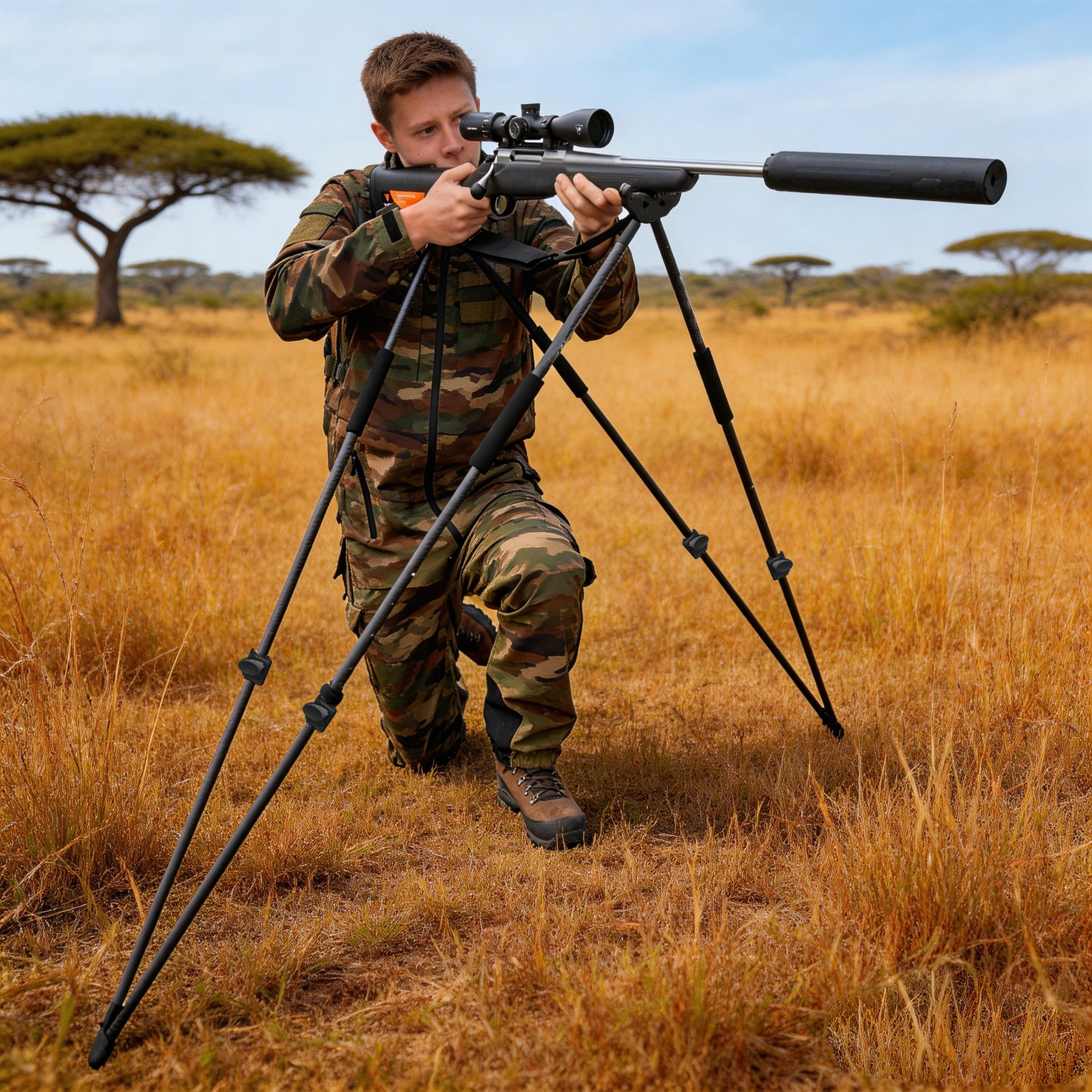
Market Positioning for Carbon Fiber Shooting Sticks
I’ve spent years walking the floors of outdoor industry trade shows, and let me tell you, the shift toward carbon fiber is impossible to ignore. If you’re managing an outdoor or hunting gear portfolio, relying solely on standard aluminum bipods is a quick way to get left behind. Today’s consumers are demanding gear that shaves ounces without sacrificing an ounce of stability, which is exactly why carbon fiber platforms are taking over the premium market segment.
We’re seeing a massive evolution in how these supports are engineered. By integrating advanced composites and moving toward ultra-stable four-legged designs, brands are solving the classic hunter’s dilemma: how to carry a lightweight rest that can still hold a heavy precision rifle dead steady at 400 yards. Let’s dive into the market positioning and figure out exactly how these innovations can elevate your product lineup.
Key innovation trends in carbon fiber shooting sticks
The innovation in composite materials isn’t just marketing fluff; it’s a measurable leap in performance. In the past, carbon fiber was seen as too brittle or too expensive for mass-market hunting gear. Now, factories are utilizing 8-layer and even 10-layer cross-directional carbon wrapping techniques. This multi-axis layup process drastically increases hoop strength, meaning the tubes won’t crush when a user clamps down on a twist lock.
We are also seeing a major trend toward modularity and extreme adjustability. For example, a modern Carbon fiber shooting stick can easily transition from a shortened length of 109cm for sitting or kneeling shots, all the way up to a max length of 175cm for standing shots. This roughly 60% extension capacity, combined with interchangeable rubber and spiked feet, allows you to market a single SKU to hunters navigating varied terrains, from muddy bogs to rocky inclines.
Best use cases for ultra-stable 4-legged shooting sticks
When we talk about ultra-stable platforms, the four-legged (or quad) stick is the undisputed king of the hill. If you’ve ever tried to hold the crosshairs steady on a standard bipod while standing, you know the wobble is real. A four-legged design creates a dual-point contact system—cradling both the forend and the buttstock of the rifle. This effectively turns a standing hunter into a human benchrest.
I always recommend targeting these ultra-stable designs for use cases involving heavy chassis rifles, long-range precision hunting, or spot-and-stalk scenarios where going prone isn’t an option. In tall brush or agricultural fields, a 4-legged shooting stick allows the user to stand comfortably while supporting a 12-to-15-pound rifle with zero muscle fatigue. It’s a game-changer for European driven hunts and Western big game pursuits alike.
Priority buyer segments for sourcing decisions
Who is actually buying these premium sticks? In my experience, you need to segment your sourcing strategy to target two primary buyer groups. The first is the ‘buy-once, cry-once’ precision hunter. This demographic is older, has higher disposable income, and is willing to drop $150 to $300 at retail for a rest that guarantees a clean shot. They care about specifications, weight ratings, and material provenance.
The second segment is the aging hunter demographic. As hunters get older, carrying heavy gear becomes a liability, and holding a rifle steady off-hand becomes significantly harder. By sourcing a lightweight carbon quad stick, you are offering a direct solution to their pain points. From a retail perspective, positioning these products in specialized pro shops and high-end direct-to-consumer funnels allows you to maintain healthy gross margins, typically in the 40% to 55% range, which easily justifies the higher initial sourcing cost.
Product Types and Core Components

Let’s break down the actual hardware. If you’re building a sourcing portfolio, you can’t just slap a logo on a generic catalog item and expect it to sell. You need to understand the anatomy of these shooting supports to spec out a product that performs flawlessly in the field.
From the carbon tubes to the internal locking mechanisms, every component dictates the final user experience. A failure at a single joint can ruin a hunt and result in costly RMA (Return Merchandise Authorization) spikes for your brand.
Differences between monopods, bipods, tripods, and quad sticks
The fundamental choice in your product line comes down to the number of legs. Monopods are your ultralight, fast-deployment option, perfect for quick stabilization but terrible for long-range precision. Bipods are the industry standard, offering a great middle ground of weight and front-end stability. Tripods introduce true free-standing capability, often crossing over into the photography and optics-glassing markets.
Then you have the quad sticks. By utilizing four legs, you eliminate the horizontal sway that plagues bipods and tripods. Below is a quick matrix I use when advising brands on how to position these different types in their catalog:
| Support Type | Avg. Setup Time | Stability Level | Ideal Engagement Range | Best For |
|---|---|---|---|---|
| Monopod | < 3 seconds | Low | 0 – 100 yards | Fast brush hunting |
| Bipod | 5 – 8 seconds | Medium | 50 – 200 yards | Spot and stalk |
| Tripod | 10 – 15 seconds | High | 100 – 300 yards | Glassing & shooting |
| Quad Stick | 10 – 15 seconds | Maximum | 150 – 400+ yards | Long-range standing shots |
Key components: tubes, joints, yokes, grips, and locks
The tubes are the skeleton, but the joints and locks are the muscles. When I’m vetting a Carbon fiber tubes tripod, I pay obsessive attention to the locking mechanisms. You generally have two choices: flip-lever locks or twist locks. Twist locks (specifically 1/4-turn or 1/2-turn designs) are visually sleeker and less prone to snagging on brush, making them highly popular for premium carbon models. However, they require internal anti-rotation shims to prevent the lower leg sections from spinning freely.
The yokes and grips are equally critical. A hard plastic yoke will scratch a beautiful wooden rifle stock and allow a synthetic stock to slip during recoil. Always specify TPR (Thermoplastic Rubber) or over-molded silicone for the V-yokes. For the grips, high-density EVA foam is the standard. It doesn’t absorb water, provides a warm touch-point in freezing weather, and resists degradation from UV exposure or sweat.
Comfort, carry weight, noise control, and field usability
Field usability ultimately boils down to three things: comfort, weight, and noise. A premium four-legged carbon stick should weigh somewhere between 2.2 and 3.5 pounds (1 to 1.6 kg). Anything heavier, and you lose the advantage of the carbon fiber; anything lighter, and you risk the stick becoming top-heavy and prone to tipping in high winds.
Noise control is a massive factor that amateur sourcers overlook. Metal-on-metal contact is a dealbreaker for hunting gear. When extending the legs, the internal bushings must glide silently. I advise my clients to implement a strict noise threshold during factory QC—deployment should register under 35 decibels at a distance of one meter. If a deer can hear the legs clacking together from 50 yards away, your product will get destroyed in customer reviews.
Carbon Fiber vs Aluminum Shooting Sticks
I get asked all the time: ‘Is carbon fiber really worth the premium over aluminum?’ The short answer is absolutely, but you have to understand the specific trade-offs to sell that value to your retail partners and end-users.
Aluminum has been the reigning champion of outdoor gear for decades because it’s cheap, easy to machine, and reasonably durable. But when we start talking about multi-leg setups that require thick tube diameters for stability, aluminum becomes a heavy burden. Let’s look at the hard data comparing the two materials.
Comparison criteria: weight, stiffness, durability, and price
When comparing these materials, we look at density, tensile strength, yield behavior, and cost. Aluminum alloys (typically 6061 or 7075 for sporting goods) have a density of about 2.7 g/cm³. Carbon fiber composite, depending on the resin ratio, sits around 1.5 to 1.6 g/cm³. This means carbon fiber is roughly 40% lighter by volume, while offering significantly higher tensile strength along the axis of the fibers.
From a pricing perspective, aluminum is a commodity. You can source a decent aluminum bipod for $12 to $18 FOB (Free On Board). A comparable carbon fiber model will command an FOB price of $25 to $45, depending on the layer count and hardware.
| Metric | Carbon Fiber (Standard 8-layer) | Aluminum (7075 Alloy) |
|---|---|---|
| Density | ~1.6 g/cm³ | ~2.7 g/cm³ |
| Yield Behavior | Snaps under extreme overload | Bends/dents under overload |
| Vibration Damping | Excellent (absorbs resonance) | Poor (transmits resonance) |
| Thermal Conductivity | Low (feels warm in cold) | High (feels freezing in cold) |
| Est. FOB Premium | +$15 to $25 per unit | Baseline Cost |
Where carbon fiber outperforms aluminum
Carbon fiber outperforms aluminum in two distinct field conditions: extreme cold and rapid follow-up shots. Because carbon fiber has incredibly low thermal conductivity, it doesn’t pull heat away from the user’s bare hands. If you are hunting in sub-zero temperatures, grabbing a bare aluminum tube is miserable; grabbing a carbon tube is entirely comfortable.
Furthermore, carbon fiber has natural vibration-damping properties. When a rifle fires, it sends a shockwave through the rest. Aluminum acts like a tuning fork, vibrating and potentially loosening the shooter’s grip or stance. Carbon fiber deadens that resonance almost instantly. This micro-level stability allows the shooter to get their eye back into the optic faster to spot their own impact or take a follow-up shot.
How 4-legged carbon fiber models compare with standard designs
When you combine carbon fiber with a quad-stick geometry, you achieve the holy grail of hunting supports. A standard aluminum quad stick is incredibly stable but can easily weigh over 4.5 pounds, making it a chore to carry through the mountains. By switching to carbon, you bring that weight down to a manageable 2.5 pounds.
This is where a 4-legged hunting stick truly shines. You are giving the customer the massive stability upgrade of four legs, but the carry weight feels like a standard aluminum bipod. It completely negates the primary objection buyers have against quad sticks (the weight), allowing you to market it as the ultimate all-day carry solution.
Supplier Vetting, Quality Control, and Compliance
Finding a factory on Alibaba that claims they can make carbon fiber sticks is easy. Finding a manufacturing partner that actually maintains tight tolerances, uses high-quality pre-preg carbon, and delivers on time? That requires a rigorous vetting process.
Quality control isn’t just about checking the final product before it goes into a shipping container; it starts with auditing the factory’s raw material supply chain and their internal testing protocols.
Factory capabilities and material traceability
When I audit a factory for carbon fiber products, the first thing I look at is their material traceability. Are they buying pre-preg (pre-impregnated with resin) carbon fiber sheets from reputable suppliers, or are they using cheap, inconsistent wet-layup methods? You want to partner with factories utilizing a roll-wrapping process with precise heat-curing ovens. This ensures the resin-to-fiber ratio is consistent across every single tube.
I also check their machining capabilities for the aluminum or magnesium joints that hold the carbon legs together. CNC machining centers with 4-axis capabilities are a must for creating the complex, tight-tolerance yokes required for ultra-stable quad sticks. If the factory is just casting these parts without secondary CNC finishing, the joints will have slop in them, ruining the stability.
Durability, noise, and lock-cycle testing
You must establish a strict testing protocol in your manufacturing agreement. For durability, I mandate a 1.5-meter drop test onto concrete. The stick must survive drops on its feet, its side, and its yoke without catastrophic failure or cracking in the carbon tubes.
Lock-cycle testing is another non-negotiable metric. A quality twist lock or lever lock should be tested to a minimum of 10,000 open/close cycles without losing its clamping force. To simulate years of field use, the metal hardware (screws, springs, and pins) must undergo a 48-hour salt spray test to ensure the anti-corrosion coatings are up to spec. If a factory balks at these testing requirements, walk away.
Compliance documents, labeling, warranties, and after-sales support
Compliance is the final hurdle before you can safely bring these products to market. Ensure all rubber and plastic components (like the grips and yokes) are REACH and RoHS compliant, meaning they don’t contain restricted heavy metals or toxic phthalates. This is especially critical if you are distributing in the European Union.
For final inspections, I highly recommend using a third-party QC agency to perform an AQL (Acceptable Quality Limit) inspection. The industry standard for premium sporting goods is AQL 1.5 for major defects (e.g., a lock that doesn’t hold weight) and AQL 4.0 for minor defects (e.g., a slight cosmetic scratch). Finally, secure a supplier agreement that includes a 12-to-24 month warranty on manufacturing defects, ensuring you have factory backing if a batch of bad resin somehow slips through.
Final Sourcing Decision Framework
Now for the fun part—putting your money where your mouth is. Sourcing isn’t just about picking a cool product; it’s about building a profitable, scalable lineup that makes sense for your brand’s bottom line.
To do that, you need a solid decision framework that accounts for every hidden cost, outlines a clear workflow, and structures your product portfolio to capture buyers at multiple price points.
Landed-cost model for tooling, MOQ, freight, and duties
Before you issue a single Purchase Order, you need a comprehensive landed-cost model. It’s not just the FOB price. You must calculate ocean freight, which currently can add $1.50 to $3.00 per unit depending on container utilization. You also need to factor in import duties; in the US, hunting accessories often fall under HTS code 9507.90, but you should verify exact classifications with your customs broker.
Don’t forget tooling costs. If you want a proprietary TPR yoke or a custom molded grip to differentiate your brand, expect to pay between $2,500 and $5,000 for injection molds. Most factories require a Minimum Order Quantity (MOQ) of 500 to 1,000 units for customized carbon fiber products. When you model all this out, a stick with a $30 FOB price might have a landed cost of $38. To hit a 50% margin, your retail price needs to sit around $79 to $89.
Step-by-step sourcing workflow
My step-by-step sourcing workflow is designed to mitigate risk. Step one is the RFQ (Request for Quote) sent to 3-5 vetted factories. Step two is purchasing off-the-shelf samples to evaluate baseline quality. Step three is ordering a custom prototype with your specific branding and yoke designs (expect a 20-30 day lead time for this).
Once the prototype is approved, step four is a pilot run. Never jump straight into a 5,000-unit order. Order the MOQ (e.g., 500 units) to test the factory’s mass-production consistency and their ability to hit the standard 45-to-60 day production lead time. Only after a successful pilot run and third-party AQL inspection should you scale up to larger container volumes.
Good-better-best portfolio decision matrix
Finally, structure your portfolio using a Good-Better-Best matrix. Your ‘Good’ tier can be a standard aluminum bipod retailing for $49—it gets people into your brand ecosystem. Your ‘Better’ tier could be a lightweight carbon fiber tripod retailing for $99, appealing to the serious enthusiast.
Your ‘Best’ tier is where the Hunting shooting stick with the 4-legged carbon fiber design sits. Priced at $149 to $199, this acts as your halo product. It showcases your brand’s commitment to innovation and captures the high-margin precision hunting demographic. By offering this tiered approach, you prevent leaving money on the table while establishing your brand as a comprehensive provider of hunting stabilization solutions.
Key Takeaways
- Prioritize carbon fiber shooting sticks when upgrading a premium hunting portfolio because they reduce carry weight while maintaining the stiffness hunters expect from stable field rests.
- Source models with multi-layer carbon tube construction, such as 8-layer or 10-layer wrapping, to improve crush resistance around twist-lock and clamp areas.
- Choose adjustable designs with a range close to 109cm to 175cm so one product can cover sitting, kneeling, and standing shooting positions.
- Use 4-legged shooting sticks to target long-range hunters and users of 12-to-15-pound precision rifles who need steadier standing support than a bipod can provide.
- Specify interchangeable rubber and spiked feet to make the same SKU practical for mud, rock, brush, agricultural fields, and uneven mountain terrain.
Frequently Asked Questions
Why are carbon fiber shooting sticks gaining share over aluminum models?
Carbon fiber offers a premium balance of low weight, stiffness, and corrosion resistance, helping hunters carry less without giving up stability. For retailers and distributors, it supports higher-value positioning than standard aluminum bipods.
What makes a 4-legged shooting stick more stable than a bipod?
A 4-legged shooting stick supports both the rifle forend and buttstock, creating a benchrest-like platform for standing or kneeling shots. This reduces wobble, especially with heavier precision rifles.
What adjustment range should buyers look for when sourcing shooting sticks?
A practical premium range is about 109cm shortened length to 175cm maximum length, allowing one SKU to serve sitting, kneeling, and standing shooting positions across varied hunting terrain.
Which hunters are the best target customers for ultra-stable quad sticks?
They are ideal for precision hunters, long-range users, European driven hunts, Western big game pursuits, and anyone using 12-to-15-pound rifles where standing stability and reduced fatigue matter.
Are interchangeable feet important for hunting shooting sticks?
Yes. Rubber and spiked feet expand terrain compatibility, letting users adapt to rocky ground, muddy fields, brush, and inclines. This improves both field performance and product value.
Post time: Jun-30-2026