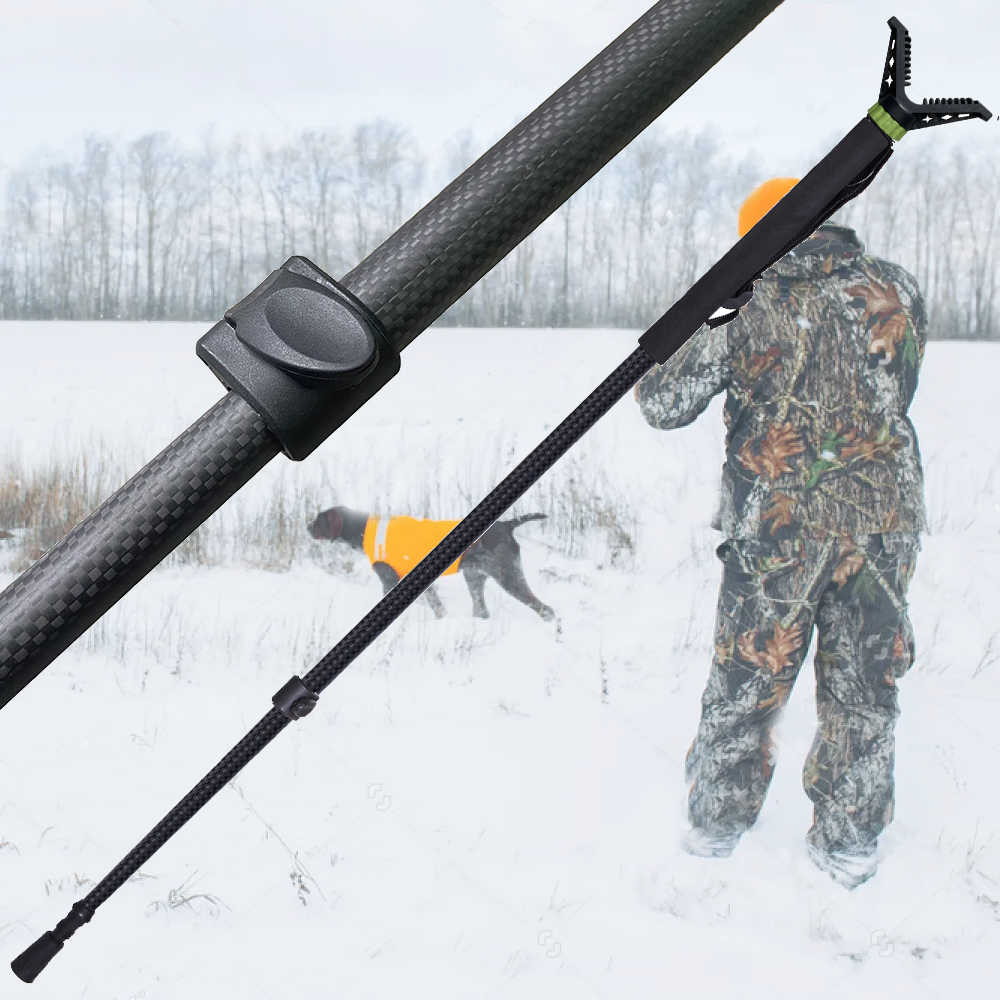
Market demand for carbon fiber monopod hunting shooting sticks
I have spent years analyzing outdoor gear trends, and the shift toward lightweight, high-stiffness support systems in the field is undeniable. When discussing a hunting shooting stick, specifically the carbon fiber monopod variants, we are looking at a global market segment growing at roughly a 6.5% CAGR. Hunters, tactical competitors, and outdoor enthusiasts are rapidly ditching heavy aluminum for advanced composites.
Let’s break down exactly why this demand is spiking and who is buying these products. If you are sourcing gear for retail or developing your own brand, understanding the commercial viability and specific use cases of these sticks is the crucial first step to building a profitable product line.
Commercial case and buyer demand
Retailers and distributors are seeing a massive shift in consumer preferences. A standard aluminum stick weighs around 800 grams, while a comparable Carbon fiber tubes monopod drops that weight to just 350–450 grams without sacrificing load capacity. For commercial buyers, the profit margin on carbon fiber is highly attractive. Wholesale costs typically sit between $15 and $28 per unit for a standard 3-section stick, which then retails anywhere from $60 to $120.
This 3x to 4x markup drives aggressive inventory stocking, especially ahead of fall hunting seasons. Wholesalers are easily moving minimum order quantities (MOQs) of 500 units, focusing heavily on markets in North America and Northern Europe. In these regions, gear weight is a primary pain point for backcountry hunters, making the premium price of carbon fiber an easy sell.
Key buyer segments and use scenarios
End-users fall into three distinct segments: backcountry hunters, tactical or precision rifle competitors, and wildlife photographers. Backcountry hunters demand ultimate portability, often hiking 10 or more miles a day with a 40-pound pack. A lightweight monopod hunting shooting stick that can double as a trekking pole to navigate steep terrain is their holy grail.
Precision shooters use these monopods as rear supports or quick-deploy front rests in dynamic competition stages. They demand high vertical load ratings, often exceeding 15 kg, to stabilize heavy rifle chassis systems. Finally, photographers use them to stabilize massive 400mm+ telephoto lenses. While each segment requires different top yoke attachments, the core carbon fiber tube architecture remains identical. This gives manufacturers and brands a versatile SKU that can serve multiple industries simply by swapping out the head.
Performance features and product specifications
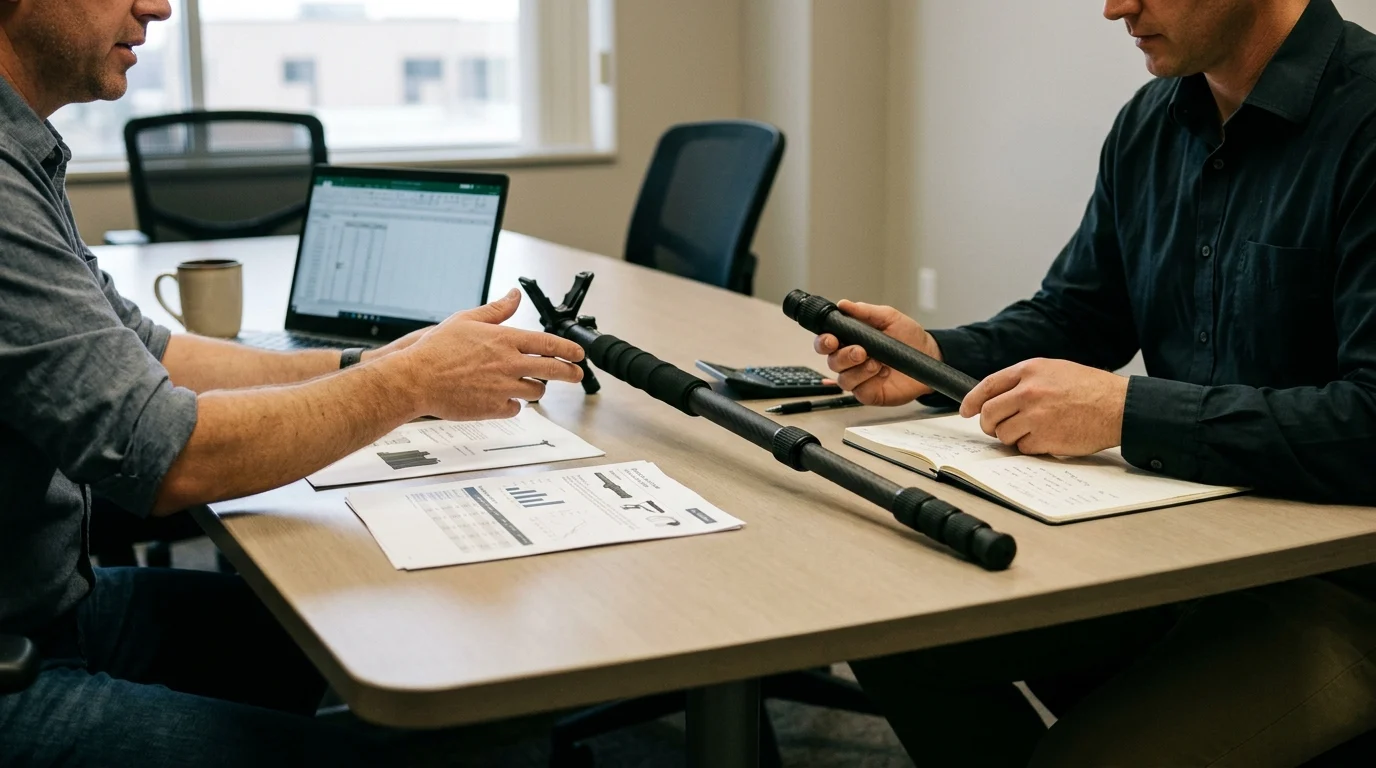
If you plan to source or sell these sticks, you must deeply understand the engineering behind them. Not all carbon fiber is created equal, and the hardware attached to the tubes dictates whether a shooting stick survives a rugged mountain hunt or fails on the first day.
Buyers must look past the marketing fluff and dig into the specifications that actually matter in the field: the composite layup, the reliability of the locking mechanisms, and the dimensional tolerances. Here are the exact numbers you should demand from suppliers.
Tube specifications, layup, and materials
The heart of the stick is the tube. Look for 3K weave carbon fiber with a multi-directional layup—usually alternating 0-, 45-, and 90-degree fiber orientations. This specific layup handles both axial downward loads and the lateral bending moments that occur when a hunter leans into the stick. Standard outer diameters (OD) for a robust monopod usually start at 28mm for the top section, tapering down to 19mm or 16mm across three to four sections.
Wall thickness is a critical specification to verify. Anything less than 1.0mm risks a catastrophic snap under a sudden side-load. A wall thickness of 1.2mm provides the optimal balance, offering a tensile strength exceeding 500 MPa while keeping the total weight under 400 grams. Furthermore, resin choice matters immensely. Insist on epoxy resins with high UV resistance; otherwise, the tubes will start to chalk and delaminate after prolonged sun exposure in the field.
Locks, tips, yokes, and stability
You can have the best carbon tubes in the world, but if the locking mechanism slips under the weight of a rifle, the stick is useless. There are generally two types of locks: twist locks and flip locks (lever locks). Twist locks, utilizing aluminum or nylon compression collets, offer a slimmer profile ideal for dense brush environments. A high-quality twist lock should require just a 1/4 turn to fully engage. Flip locks are faster to deploy and easier to manipulate with thick winter gloves, but they add bulk and can snag on gear.
Moving to the extremities, the base should feature a tungsten carbide tip hidden under a removable or retractable rubber foot. This dual setup ensures a solid grip on both slick rock and soft dirt. At the top, the yoke (often a V-yoke with rubberized over-molded fins) usually mounts via a standard 1/4″-20 or 3/8″-16 threaded stud. This universal threading is vital, as it allows users to unscrew the hunting yoke and swap in an Arca-Swiss ball head for photography or precision shooting.
How to compare product performance
When evaluating different models for a product lineup, building a performance matrix is helpful. You must carefully balance maximum deployed height, collapsed length, total weight, and maximum load capacity. Adding more sections makes the stick pack down smaller but introduces more failure points and thinner bottom tubes.
Here is a quick benchmarking table to compare standard configurations:
| Configuration | Max Height (cm) | Collapsed Length (cm) | Weight (g) | Max Load (kg) |
|---|---|---|---|---|
| 3-Section | 160 | 65 | 380 | 15 |
| 4-Section | 170 | 54 | 420 | 12 |
| 5-Section | 175 | 45 | 460 | 10 |
As the data shows, upgrading from a 3-section to a 5-section stick reduces the collapsed length by 20 cm, making it much easier to strap to a backpack. However, it increases the weight to 460g due to the extra locking hardware, and it drops the maximum load capacity by 33% because the bottom tube OD becomes perilously thin, often dropping to just 13mm.
Sourcing, manufacturing quality, and cost
Finding a reliable supplier for a monopod hunting tool is much more complex than browsing wholesale directories. The carbon fiber sporting goods manufacturing hub is heavily concentrated in specific regions of Asia, primarily in Weihai and Dongguan, China.
The difference between a premium factory and a low-tier workshop lies entirely in their quality control processes and raw material sourcing. Here is how to navigate the sourcing landscape and control costs.
Production process and quality control
Premium carbon tubes are roll-wrapped using pre-preg carbon fiber. In a top-tier facility, the pre-preg sheets are precision-cut, rolled onto steel mandrels, shrink-wrapped with OPP tape to apply compression, and then cured in an autoclave at roughly 130°C to 150°C. Lower-tier factories might try to substitute this with pultrusion, which aligns fibers only in one direction, making the stick incredibly prone to longitudinal splitting. You must explicitly specify roll-wrapped tubes in your purchase agreements.
Auditing a factory’s QC line before placing an order is essential. They should conduct a 100% visual inspection for resin voids and surface blemishes. More importantly, they need a 100% functional testing protocol for the locking mechanisms. Every single stick should be pull-tested to at least 20 kg of axial force to ensure zero slip before it goes into a box.
Cost drivers, MOQ, and packaging
The primary cost drivers for these sticks are the grade of the carbon fiber tow (Toray T300 or T700 is the industry standard) and the CNC machining of the aluminum locking components. A high-end stick utilizing T700 carbon and 7075-T6 aerospace aluminum locks will cost a buyer around $22 to $28 FOB. Dropping to generic carbon fiber and utilizing nylon plastic flip locks can aggressively push the price down to $14 to $16 FOB.
Typical MOQs range from 300 to 500 units for off-the-shelf designs. However, if you require custom tooling for a proprietary yoke design or a patented cam-lock, expect the MOQ to jump to 1,000 or more units. Packaging also heavily impacts landed costs via shipping density. Sourcing unassembled units in plain PE bags is recommended if you are doing final assembly or kitting locally. If shipping straight to retail shelves, expect to pay an extra $0.80 to $1.50 per unit for custom blister packs or printed retail boxes.
Supplier comparison criteria
When vetting new suppliers, do not just look at the bottom-line unit price. Assess their historical scrap rate, standard lead times (which typically run 30 to 45 days for a 2,000-unit production run), and financial ability to handle warranty claims. Always ask to see defect rate data; a world-class factory will maintain a defect rate strictly below 1.5%.
Verify whether the factory has in-house CNC capabilities for the aluminum parts or if they outsource to third-party machine shops. In-house machining drastically reduces lead-time delays and ensures that the threading on the 1/4″-20 mounting studs is perfectly concentric. Outsourced machining often leads to finger-pointing when a batch of sticks arrives with cross-threaded mounts.
Compliance, durability, and field risks
Outdoor gear gets severely abused. A monopod will be dropped on jagged rocks, submerged in freezing mud, and occasionally used as a makeshift pry bar to navigate steep inclines. Therefore, understanding the mechanical thresholds of the product is non-negotiable.
Beyond physical toughness, there is a regulatory side to importing these tools. Ensuring compliance with international standards is critical for protecting brand liability and ensuring shipments do not get tied up in customs.
Mechanical and environmental testing
To guarantee field durability, insist on three specific mechanical tests before signing off on a production batch. First is the axial load test: the fully extended stick must support a static vertical load of 15 kg for 24 hours. During this period, the locks must not slip more than 2mm. Second is the three-point bending test, which simulates a hunter leaning heavily on the middle of the stick. The carbon tube should withstand a bending moment of at least 30 N·m before any audible fiber fracture occurs.
Finally, require environmental chamber testing. The stick must be cycled repeatedly between -20°C and +60°C. This thermal cycling is crucial because carbon fiber and aluminum have mismatched thermal expansion coefficients. If manufacturing tolerances are poor, extreme cold can cause the aluminum lock collars to seize entirely, while extreme heat can cause them to expand and slip under load.
Labeling and market-entry compliance
While shooting accessories are not as heavily regulated as actual firearms, they still fall under general consumer product safety and chemical guidelines. If importing into the European Union, ensure strict compliance with REACH regulations. This specifically targets the chemicals used in the rubber grips and V-yokes; substances like phthalates and PAHs must be kept below 0.1% by weight.
In the United States, California’s Proposition 65 requires specific warning labels if the rubber or polymer components contain restricted chemicals. Ignoring this can lead to massive fines. Furthermore, accurate country-of-origin labeling (e.g., a permanent “Made in China” sticker or engraving) must be affixed to the product itself or its immediate packaging. Failing to include this can result in shipments being held at the port and hit with a 10% penalty fee by customs.
Final evaluation and buying decision
 Having covered the market dynamics, engineering specifications, manufacturing landscape, and compliance risks, how do we bring all this data together to make a smart, profitable purchasing decision?
Whether you are a retail buyer stocking up for the upcoming season or a direct-to-consumer brand designing a new flagship product, the final evaluation always comes down to balancing weight, stability, and cost. Here is how to finalize those decisions.
Step-by-step product evaluation
A methodical product evaluation process is essential. First, request physical production samples of both 3-section and 4-section models. Immediately check the lock actuation. The twist or flip locks should feel crisp, with absolutely no gritty feedback—grit indicates poor CNC machining tolerances or residual carbon dust from the factory floor. Next, extend the stick fully and apply lateral pressure to the middle section. Look for excessive flex; anything more than an inch of deflection under a 5 kg side load is an immediate red flag.
Then, inspect the V-yoke’s over-molding. The rubberized material should be chemically bonded to the polymer core. If the rubber can be peeled off with a thumbnail, it is guaranteed to tear off in the field after a few uses. Lastly, verify the thread pitch on the mounting stud with a calibrated stainless steel nut to ensure perfect compatibility with aftermarket camera and rifle chassis mounts.
Decision criteria for weight, stability, and value
Ultimately, the buying decision should map directly to the target customer’s primary use case. To simplify this process, use a value matrix based on the end-user profile to determine the exact specifications needed.
| Target Customer | Recommended Configuration | Key Feature Priority | Target Retail Price | Max Weight Limit |
|---|---|---|---|---|
| Backcountry Hunter | 4-Section Twist Lock | Compact folded length (<55cm) | $80 – $120 | 400g |
| Blind/Stand Hunter | 3-Section Lever Lock | Fast deployment, high stiffness | $60 – $90 | 500g |
| Precision/Tactical | 3-Section Heavy Duty | High load capacity (>15kg) | $100 – $150 | 600g |
If targeting the backcountry hunter, ruthlessly prioritize weight and collapsed length, accepting the slightly higher manufacturing cost of a 4-section design. For stand hunters, raw durability and fast deployment trump weight, making a robust 3-section aluminum flip-lock design the clear winner. By aligning the technical specifications with the correct price band and user requirements, you guarantee a product that not only sells well but earns the field reputation required for long-term brand success.
Key Takeaways
- The most important conclusions and rationale for hunting shooting stick
- Specs, compliance, and risk checks worth validating before you commit
- Practical next steps and caveats readers can apply immediately
Frequently Asked Questions
Why choose a carbon fiber monopod hunting shooting stick over aluminum?
Carbon fiber cuts weight to about 350–450g versus roughly 800g for aluminum, making long hikes easier while maintaining strong stiffness and field stability.
What load capacity should a hunting shooting stick support?
For rifles and heavy setups, choose a monopod rated above 15kg. This helps prevent flex or collapse during quick shots or uneven terrain use.
Which tube specs matter most when buying a carbon fiber shooting stick?
Look for 3K carbon fiber, multi-directional layup, and about 1.2mm wall thickness. These specs improve strength, reduce snap risk, and keep total weight low.
Are twist locks or other locking systems important?
Yes. Reliable locks are critical because slipping sections can ruin stability. Test for secure hold under load and repeated extension before buying or sourcing in volume.
Can a monopod hunting shooting stick be used for more than hunting?
Yes. By changing the top attachment, it can support tactical shooting, wildlife photography, or even function as a trekking pole for backcountry travel.
Post time: May-19-2026