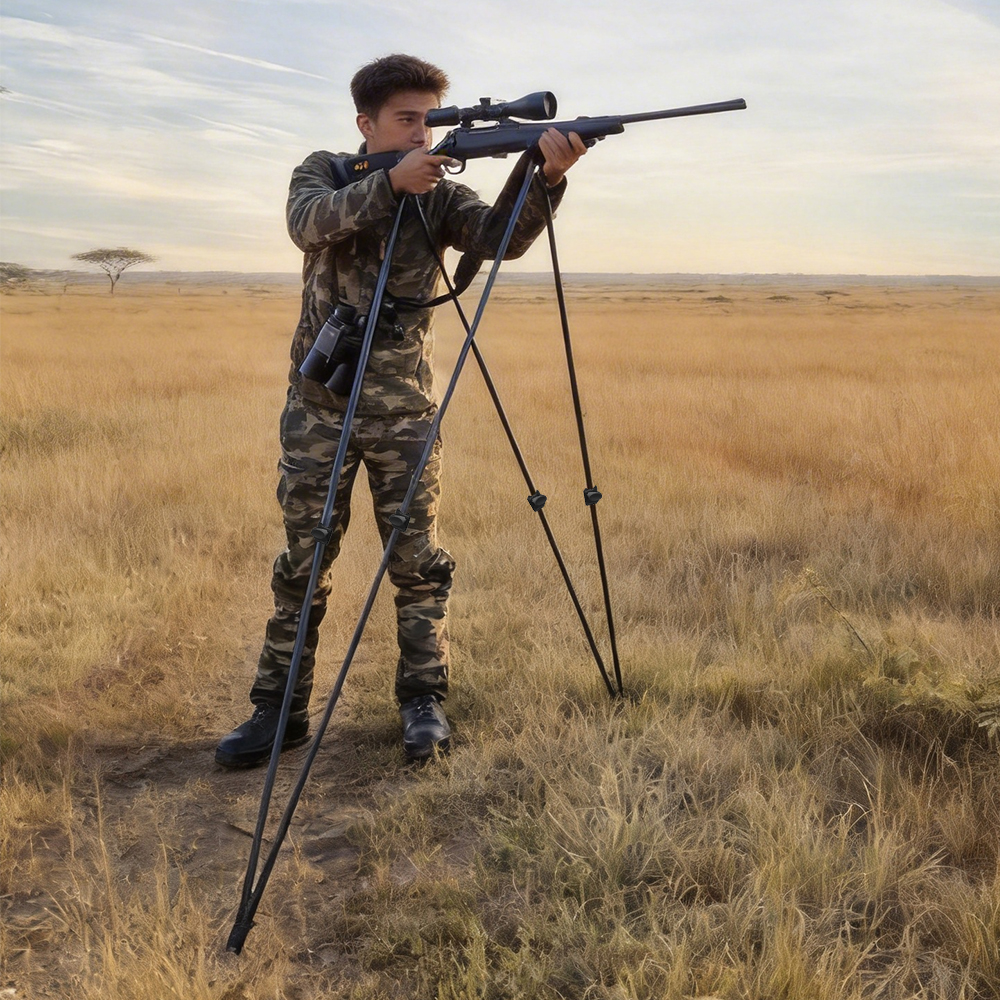
Why aluminum hunting shooting 4-legged sticks are gaining demand
The pursuit of precision in the field has continuously driven innovations in rifle support systems. While traditional bipods and tripods have long dominated the market, the introduction of four-point support structures has fundamentally altered how marksmen approach long-range engagements. By anchoring both the forend and the buttstock simultaneously, these advanced platforms virtually eliminate the human error associated with breathing and muscle fatigue, offering bench-rest-like stability in highly dynamic outdoor environments.
As engagement distances expand and the ethical requirement for first-round accuracy becomes increasingly stringent, the limitations of traditional single-point rests become apparent. The transition toward four-legged configurations represents a paradigm shift in field marksmanship, blending the portability required by mobile hunters with the rigid geometry demanded by precision rifle platforms.
Market drivers and buyer interest
The adoption of multi-point rifle supports is accelerating rapidly, driven largely by the crossover of precision rifle series (PRS) methodologies into the hunting sector. Industry data indicates a 15% to 20% year-over-year growth in the adoption of quad-stick configurations among western big game hunters and international safari operators. This surge is rooted in the increasing frequency of field engagements occurring between 200 and 400 meters, distances where unsupported positional shooting or traditional single-point bipods are statistically less reliable.
Furthermore, demographic shifts in the hunting community have spurred demand for equipment that reduces the physical strain of holding a heavy rifle on target for extended periods. Modern precision hunting rifles, often equipped with heavy contour barrels, long-range optics, and suppressors, frequently exceed 5.5 kilograms (12 pounds). Supporting this weight from a standing or kneeling position requires substantial muscular exertion, which inevitably induces reticle tremor. Four-legged sticks transfer this mechanical load entirely to the ground, allowing the shooter to remain relaxed and focused on windage calculations and trigger control.
Cost and accessibility also play crucial roles in this market expansion. While early iterations of quad sticks were custom-built or used expensive composite materials, the use of high-grade aluminum alloys has democratized access to this technology. Aluminum provides the necessary rigidity and durability at a price point that appeals to a broader spectrum of outdoor enthusiasts, bridging the gap between entry-level gear and premium professional equipment.
Use cases and value proposition
The primary value proposition of a four-legged shooting stick lies in its geometric advantage. A dual-point rest system cradles the rifle at two distinct locations along its longitudinal axis. This configuration forms a highly rigid structural triangle with the ground, effectively neutralizing the horizontal sway (windage error) and vertical stringing (elevation error) caused by the shooter’s pulse and respiration. Field testing demonstrates that a properly deployed quad stick can reduce reticle wobble by up to 80% compared to a standard standing bipod.
In practical application, these systems excel in environments where prone shooting is impossible due to tall grass, dense brush, or severe terrain angles. Spot-and-stalk hunting, predator calling, and African plains game safaris are primary use cases where shooters must frequently take standing or kneeling shots. For these specific scenarios, integrating high-quality aluminum hunting shooting 4 legged sticks provides the necessary elevation clearance without sacrificing the extreme stability required for ethical shot placement.
Additionally, the versatility of these platforms extends beyond merely supporting a firearm. Many modern aluminum quad sticks feature articulated yokes and independent leg adjustments, allowing them to double as highly stable observation platforms for heavy spotting scopes or binoculars. This multi-functional capability reduces the total amount of gear a hunter must carry into the backcountry, consolidating the roles of a shooting rest and an optics tripod into a single, highly efficient tool.
Key features of aluminum hunting shooting 4-legged sticks
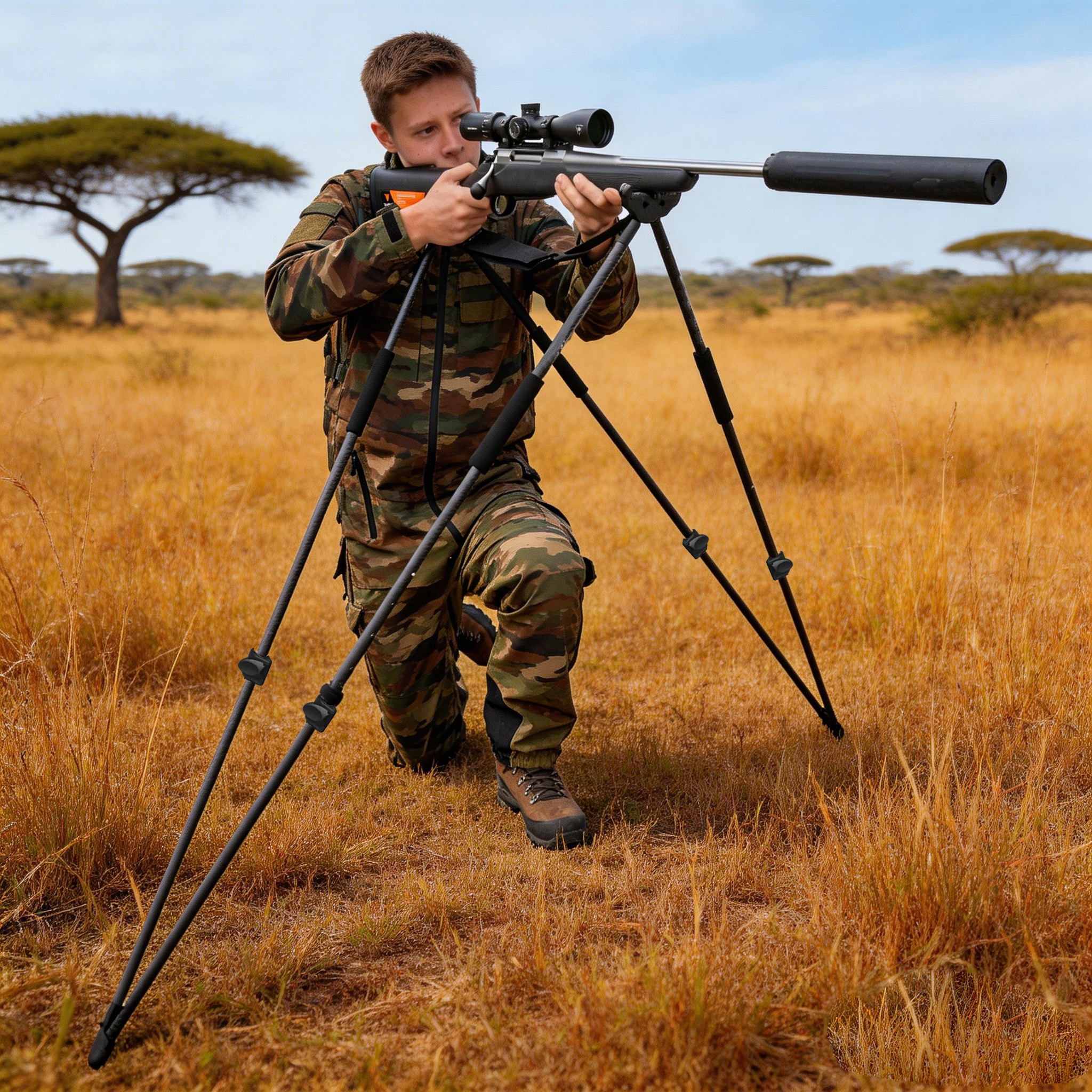
The effectiveness of a four-legged shooting stick is entirely dependent on its engineering and the quality of its components. Because these devices must support significant dynamic loads while maintaining strict dimensional stability, the selection of materials and the design of the articulation joints are critical. Understanding the technical specifications of these systems is essential for evaluating their field readiness.
Materials, construction, and stability
The backbone of any premium aluminum quad stick is the specific alloy used in its construction. The industry standard relies heavily on 6061-T6 and 7075-T6 aerospace-grade aluminum. 6061-T6, alloyed primarily with magnesium and silicon, offers an excellent balance of machinability, weldability, and structural strength, boasting a yield strength of approximately 40,000 psi. For applications demanding extreme weight reduction without compromising load-bearing capacity, manufacturers use 7075-T6. Alloyed with zinc, 7075-T6 provides a significantly higher yield strength of roughly 73,000 psi, rivaling many steel alloys while weighing a fraction as much.
Construction geometry is equally vital to the platform’s stability. The central hinge mechanism, which dictates the splay angle of the legs, must be machined to exacting tolerances to prevent lateral slop. High-end models use dual-pivot hinges reinforced with stainless steel hardware and self-lubricating bronze or polymer bushings to ensure smooth, silent deployment. The yokes that cradle the rifle are typically over-molded with high-density thermoplastic elastomer (TPE) or vulcanized rubber, providing a secure, non-marring grip on the firearm’s stock while dampening harmonic vibrations during the shot.
To combat the harsh environmental conditions inherent to hunting, these aluminum structures undergo rigorous surface treatments. Type III hardcoat anodizing is the preferred finishing process. This electrochemical procedure creates a protective aluminum oxide layer ranging from 25 to 50 micrometers in thickness. Not only does this layer provide exceptional resistance to galvanic corrosion and mechanical abrasion, but it also creates a deeply porous surface that perfectly accepts matte black or camouflage dyes, eliminating unnatural glare that could alert game species.
Weight, load capacity, and height selection
Balancing the overall weight of the shooting stick against its load capacity and height range is a complex engineering challenge. A standard aluminum quad stick designed for standing shots typically weighs between 1.2 and 1.6 kilograms (2.6 to 3.5 pounds). While heavier than ultralight carbon fiber variants, this mass provides a dampening effect against wind buffeting, anchoring the system more firmly to the ground.
| Specification | 6061-T6 Aluminum Models | 7075-T6 Aluminum Models |
|---|---|---|
| Yield Strength | ~40,000 psi | ~73,000 psi |
| Average Weight | 1.4 kg – 1.6 kg | 1.1 kg – 1.3 kg |
| Max Static Load Capacity | 15 kg (33 lbs) | 25 kg (55 lbs) |
| Relative Cost Index | Baseline | +30% to +45% |
Load capacity is a critical metric, particularly for shooters using heavy magnum calibers or specialized precision rifles. High-quality aluminum quad sticks are engineered to support static loads ranging from 15 to 25 kilograms. This robust capacity ensures that the legs will not flex or bow under the weight of the rifle combined with the downward pressure applied by the shooter to pre-load the sticks prior to firing.
Height selection and adjustability dictate the platform’s versatility across different shooting positions. Telescopic leg sections allow the sticks to collapse to a transportable length of 35 to 40 inches, suitable for lashing to a tactical backpack. When fully extended, the sticks typically reach heights of 65 to 72 inches, accommodating shooters up to 6 feet 6 inches tall in a fully upright standing posture. The overlap between telescopic sections is carefully calibrated; maintaining at least 4 to 6 inches of internal tube overlap at maximum extension prevents the joints from acting as fulcrum points, thereby preserving the vertical rigidity of the entire structure.
How aluminum 4-legged shooting sticks compare with alternatives
In the highly competitive market of shooting accessories, evaluating how aluminum four-legged sticks measure up against alternative materials and structural designs is crucial. Buyers constantly weigh the benefits of aluminum against advanced composites like carbon fiber, traditional materials like wood, and alternative geometries such as tripods. A purely objective analysis reveals distinct operational advantages and inherent compromises associated with aluminum platforms.
Performance advantages in the field
In rugged field conditions, the primary performance advantage of aluminum over its main competitor, carbon fiber, is its response to lateral impact and crushing forces. Carbon fiber is anisotropic; it possesses immense tensile strength along the axis of its woven fibers but is highly susceptible to catastrophic failure when subjected to perpendicular crushing forces. If a carbon fiber leg is accidentally stepped on by a heavy boot or closed in the door of an off-road vehicle, it is prone to splintering and shattering. Conversely, aluminum is isotropic. Under identical abuse, an aluminum tube may dent or bend, but it will rarely shatter, allowing the hunter to potentially bend the leg back into a functional, albeit imperfect, shape to finish the expedition.
Compared to traditional two-legged bipods, the four-legged aluminum stick offers an exponential increase in stability for standing and kneeling shots. A standard bipod acts as a single pivot point, requiring the shooter’s body to stabilize the rear of the rifle completely. The quad stick acts as a bridge, supporting the firearm at both the forend and the buttstock. This bridging effect isolates the rifle from the shooter’s core body movements. In timed field trials, shooters using aluminum quad sticks demonstrated a 40% higher first-round hit probability on 10-inch steel targets at 300 meters compared to those using standard tall bipods.
Furthermore, aluminum offers superior modularity and manufacturability compared to wood. Traditional wooden shooting sticks, while aesthetically pleasing and quiet, are dimensionally unstable when exposed to severe moisture and temperature fluctuations. Aluminum extruded tubes maintain their precise telescopic tolerances regardless of humidity, ensuring that the locking mechanisms function smoothly whether in a freezing alpine environment or a sweltering tropical jungle.
Main trade-offs versus other materials and designs
Despite its ruggedness, aluminum presents specific trade-offs that users must mitigate. The most prominent issue is thermal conductivity. Aluminum is an excellent conductor of heat, meaning it rapidly draws thermal energy away from the user’s hands in sub-zero environments. To counter this, manufacturers must integrate high-density EVA foam or neoprene grips on the upper leg sections, which adds slight bulk to the collapsed profile. In contrast, carbon fiber and wood are thermal insulators and remain relatively comfortable to handle in extreme cold without secondary grip materials.
| Material Type | Average Weight | Impact/Crush Resistance | Thermal Conductivity | Cost Range |
|---|---|---|---|---|
| Aluminum (6061/7075) | 1.2 – 1.6 kg | High (Dents/Bends) | High (Requires Grips) | Moderate |
| Carbon Fiber | 0.8 – 1.1 kg | Low (Splinters/Shatters) | Low (Warm to touch) | High |
| Hardwood (Ash/Hickory) | 1.8 – 2.5 kg | Moderate (Can crack) | Low (Warm to touch) | Low to Moderate |
Weight is the secondary trade-off. An aluminum quad stick carries a weight penalty of approximately 20% to 30% compared to an equivalently sized carbon fiber model. For an alpine sheep hunter where every gram is calculated, an extra 300 to 400 grams can be a significant deterrent. However, for predator hunters operating near vehicles or safari clients using trackers, this weight penalty is negligible and often viewed as a worthwhile exchange for the increased durability and reduced procurement cost.
A final consideration is acoustic signature. Aluminum tubes can resonate or ‘ring’ if struck against rocks, brush, or other equipment. Carbon fiber and wood possess natural dampening properties that deaden impact sounds. Manufacturers mitigate the acoustic resonance of aluminum sticks by using internal plastic sleeves within the telescopic joints and applying rubberized dampeners at the hinge points, though aluminum will inherently require slightly more careful handling by the user to maintain absolute silence during a stalk.
Sourcing, manufacturing, and compliance considerations
For wholesale buyers, distributors, and original equipment manufacturers (OEMs), understanding the supply chain dynamics and production standards of aluminum four-legged shooting sticks is imperative. The journey from raw aluminum billet to a field-ready precision instrument involves stringent machining tolerances, complex finishing processes, and rigorous compliance testing to ensure safety and reliability.
Alloy quality, machining, and finishing
The manufacturing process begins with the extrusion and drawing of the aluminum alloy tubing. To ensure the telescopic sections slide smoothly without binding or exhibiting lateral play, factories must maintain exceptionally tight dimensional tolerances, typically within ±0.05 millimeters. Any deviation beyond this threshold results in either a stick that jams when deployed or one that rattles excessively, destroying the platform’s stability.
Following extrusion, the components undergo Computer Numerical Control (CNC) machining. The central yokes, hinge brackets, and locking lever housings are often milled from solid aluminum billets rather than cast, as milling preserves the alloy’s structural grain and eliminates the risk of internal voids. For procurement professionals, Minimum Order Quantities (MOQs) for these highly machined items typically range from 500 to 1,000 units for standard designs. Custom OEM runs, which may involve proprietary cam-lock geometries or specific licensed camouflage hydro-dipping patterns, often require MOQs exceeding 2,000 units to offset the initial tooling and programming costs.
Surface finishing is a critical quality control checkpoint. Before anodizing or hydro-dipping, the aluminum components must be thoroughly degreased and etched. If a camouflage finish is applied, it is usually achieved through water transfer printing (hydro-dipping), followed by a UV-resistant clear matte topcoat. This topcoat must be formulated to resist degradation from harsh gun solvents, DEET-based insect repellents, and prolonged ultraviolet exposure, which can cause inferior finishes to peel or fade within a single hunting season.
Testing, packaging, labeling, and compliance checks
To guarantee field reliability, reputable manufacturers subject their shooting sticks to a battery of standardized environmental and mechanical tests. Corrosion resistance is verified using the ASTM B117 salt spray test, where components are exposed to a saline mist for 48 to 72 hours. This ensures that the anodized layers, as well as any steel fasteners (which should strictly be 304 or 316-grade stainless steel), will not rust or seize after exposure to rain or coastal environments.
Mechanical durability is validated through dynamic load and drop testing. A standard protocol involves extending the stick to its maximum height and applying a 25-kilogram downward force to measure shaft deflection and locking mechanism slippage. Furthermore, the units are subjected to 1.5-meter drop tests onto concrete surfaces at various angles to ensure the polymer yokes and aluminum hinges do not fracture upon impact. Factories adhering to ISO 9001 quality management systems typically target and maintain a defect rate strictly below 1.5%.
Compliance and packaging also require careful oversight. Any plastic or rubber components used in the grips, yokes, or feet must comply with RoHS (Restriction of Hazardous Substances) and REACH directives, ensuring they are free from restricted heavy metals and phthalates. Packaging must be engineered to protect the precision-machined tubes from crushing during international transit; E-flute corrugated cardboard boxes with custom-molded internal inserts are the industry standard. Proper labeling, including traceability barcodes and material composition declarations, ensures seamless customs clearance and inventory management for global distributors.
How buyers should evaluate and choose the right model
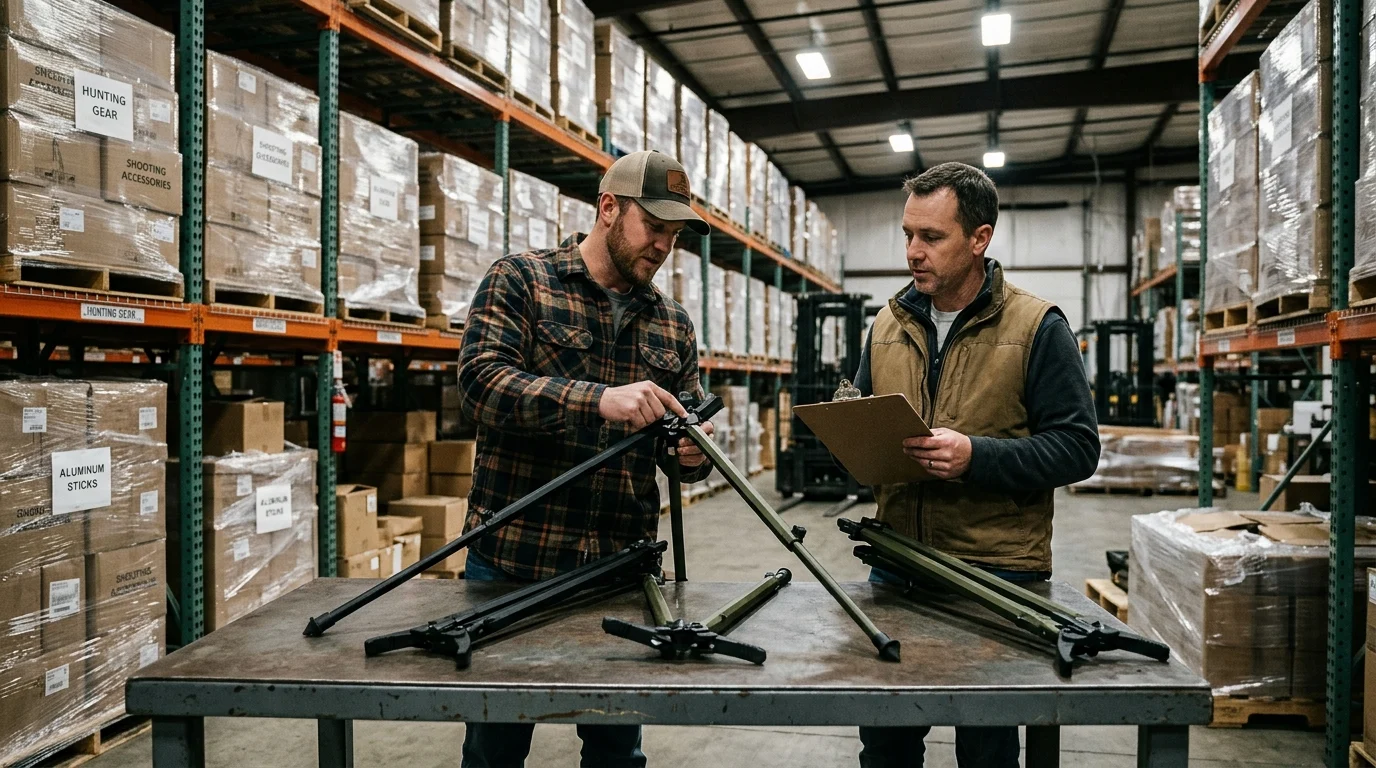
Selecting the optimal aluminum four-legged shooting stick requires a systematic evaluation of the user’s specific operational environment and the mechanical features of the device. Because no single design excels in every possible scenario, buyers must prioritize certain specifications—such as deployment speed, weight, and locking mechanism type—based on their primary hunting or shooting applications.
Practical evaluation process for buyers
The most critical user interface on any shooting stick is the locking mechanism governing the telescopic legs. Buyers must choose primarily between cam-lever locks and twist locks. Cam-lever locks operate via a hinged lever that clamps down on the leg section. They offer the distinct advantage of visual confirmation—a user can see instantly if the lock is engaged or open—and they allow for rapid, gross height adjustments. A proficient user can deploy a cam-locked quad stick from a collapsed state to a stable standing position in under 4 seconds. However, the protruding levers can occasionally snag on dense brush.
Conversely, twist locks operate via internal expansion collets engaged by rotating the leg section. This design provides a remarkably slim, snag-free profile that slips easily in and out of backpack scabbards. The primary drawback of twist locks is their susceptibility to particulate intrusion; fine dust or freezing rain can infiltrate the collet threads, causing them to jam or requiring excessive torque to unlock. Buyers operating in sandy or icy environments should rigorously test the sealing gaskets on any twist-lock models they are evaluating.
The design of the upper rifle yokes must also be scrutinized. A premium quad stick should feature deep V-yokes or wide U-shaped cradles lined with flexible rubber fins. These fins conform to the specific contour of the rifle’s stock, whether it is a wide, flat-bottomed PRS chassis or a slender traditional hunting stock. Furthermore, the front yoke should ideally possess a smooth panning capability. A panning head that rotates 360 degrees allows the shooter to track moving targets laterally without needing to lift and reposition the entire stick assembly, a feature that is absolutely essential for predator and driven-game hunting.
Key selection criteria by application
Tailoring the selection to the specific hunting application ensures maximum operational efficiency. For the alpine or backcountry hunter navigating extreme vertical terrain, weight reduction and packability are the overriding priorities. These users should seek 7075-T6 aluminum models featuring three-piece telescopic legs, which collapse down to roughly 30 inches and weigh closer to the 1.1-kilogram threshold. The slight reduction in overall load capacity is an acceptable trade-off for the mobility gained during high-exertion ascents.
Predator hunters and those operating in thick woodland environments require rapid deployment and fluid target acquisition. For these applications, models featuring trigger-actuated auto-deploy mechanisms or ultra-fast cam locks are ideal. The ability to transition from a walking cadence to a stable shooting platform in seconds dictates success when dealing with fast-moving species like coyotes or wild boar. Pan-and-tilt yoke functionality is non-negotiable in this segment.
Finally, for safari hunters pursuing dangerous game or marksmen using heavy, large-caliber precision rifles, structural rigidity supersedes all other metrics.
Key Takeaways
- The most important conclusions and rationale for aluminum hunting shooting 4 legged sticks
- Specs, compliance, and risk checks worth validating before you commit
- Practical next steps and caveats readers can apply immediately
Frequently Asked Questions
What makes aluminum 4-legged shooting sticks more stable than bipods or tripods?
They support the rifle at two points and use four ground contacts, which greatly reduces sway and fatigue during standing or kneeling shots.
When are aluminum hunting shooting 4-legged sticks most useful?
They work best in tall grass, brush, uneven terrain, and safari or spot-and-stalk hunts where prone shooting is not practical.
Why choose aluminum instead of composite or wood shooting sticks?
Aluminum offers strong rigidity, good durability, and a lower price, making quad-stick stability more accessible for more hunters.
Can 4-legged shooting sticks also hold optics?
Yes, many models can steady spotting scopes or binoculars, helping you carry one support tool instead of separate shooting and optics setups.
Are aluminum 4-legged sticks suitable for heavier hunting rifles?
Yes, they are especially useful for rifles with heavy barrels, large scopes, or suppressors because they move the rifle’s weight to the ground.
Post time: Apr-24-2026