Introduction
Selecting adjustable quad shooting sticks for a tactical accessories distribution business requires more than comparing unit prices or picking a popular catalog item. The right choice depends on how well the product matches end-user needs, margin targets, factory capability, and the shipping realities of longer, specialized gear. This article outlines the key criteria to evaluate before adding quad shooting sticks to your lineup, from build quality and adjustment mechanisms to supplier reliability and packaging considerations. By the end, you will have a practical framework for choosing products that strengthen your assortment, support reseller demand, and improve profitability without introducing avoidable sourcing risk.
How to Choose Adjustable Quad Shooting Sticks
When I first started scaling my tactical gear catalog, I realized I was leaving serious money on the table by ignoring specialized stabilization gear. The market is flooded with standard bipods and basic tripods, but adding Adjustable Quad Shooting Sticks to your lineup isn't just a niche play; it's a strategic move that can significantly boost your average order value. In my experience, tactical distributors face constant pressure from direct-to-consumer brands on standard items, which makes finding high-margin, specialized gear absolutely essential for long-term survival.
Typically, we see gross margins hovering around 35% to 45% for high-quality stabilization gear, which is noticeably better than the razor-thin 15% to 20% margins we often settle for on generic accessories. Sourcing these effectively requires a deep dive into the mechanics of the sticks, the capabilities of the factories, and the logistics of moving long-format items. Let's break down exactly how I approach sourcing these four-legged sticks so you can confidently add them to your distribution portfolio and protect your bottom line.
Match the Stick to Your Hunting Style
The first thing I always tell my purchasing team is that we can't just buy a generic stick and hope it sells. We have to meticulously match the stick to the specific hunting, tactical, and competitive shooting styles of our end-users. Quad sticks have gained immense popularity because they offer four distinct points of contact with the ground. When properly deployed, they essentially lock the rifle in a vise-like grip, supporting both the forend and the buttstock simultaneously. This reduces crosshair wobble to near zero, which is a massive selling point for hunters or tactical shooters taking precision shots well past the 300-yard mark.
You also have to seriously consider the terrain your target demographic navigates. I strictly look for sticks that can handle highly uneven ground, easily accommodating slopes up to 30 or even 40 degrees without losing their center of gravity. If your core customer base hunts in dense brush, rocky outcrops, or steep mountainous regions, the leg articulation and independent adjustability of each leg become the primary features you'll use in your marketing copy. A stick that works perfectly on a flat shooting range might be completely useless on a rocky hillside, so understanding the field application dictates everything from the leg spread angle to the foot spike design.
Set a Realistic Budget and Value Target
Before reaching out to any overseas factory or domestic supplier, I sit down and set a hard budget and value target. In this industry, it is incredibly easy to get distracted by flashy features, carbon fiber weaves, and tactical branding, but the raw numbers have to make sense first. For a solid mid-tier aluminum quad stick, I aim for a wholesale FOB (Free On Board) cost between $25 and $35 per unit. This specific cost basis allows me to set a competitive retail MSRP of $89 to $119, hitting that high-volume sweet spot for weekend warriors and serious hunters alike without pricing them out.
On the other hand, if I am specifically targeting the premium market with ultra-lightweight carbon fiber models, I am willing to push my wholesale cost up to $65 or even $85 per unit. For these, I target a retail price of $199 to $249. Knowing these exact financial boundaries upfront keeps me grounded during factory negotiations. It ensures that every single SKU I add to the catalog meets my minimum ROI threshold of a 150% markup from the landed cost. If a factory quotes me $45 for an aluminum stick that I can only sell for $99, I immediately pass and move on to the next vendor.
Key Specifications to Compare
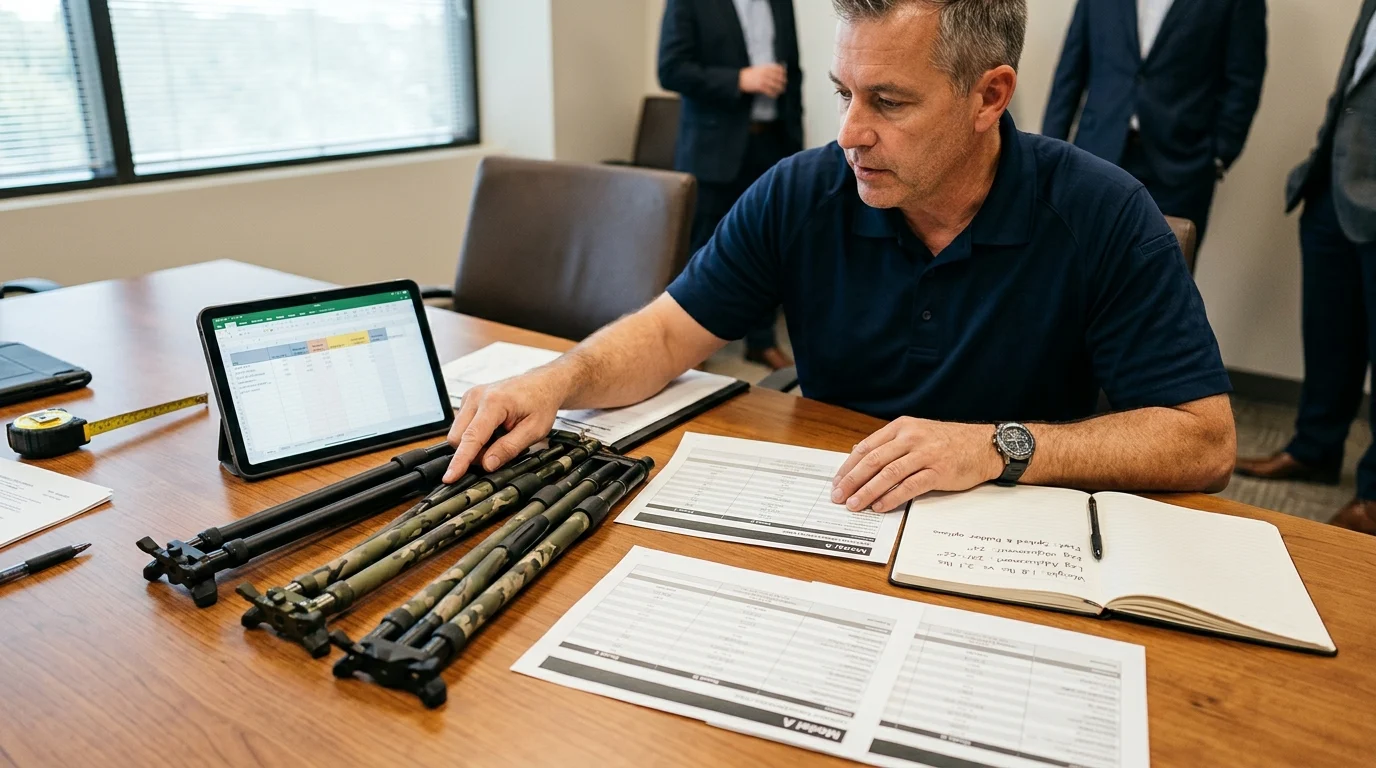
Once the budget constraints are locked in, I get absolutely ruthless about the physical specifications. You cannot fake quality when dealing in Tactical Accessories; the end-user will immediately know if a product feels cheap, flimsy, or unstable the moment they bear weight on it in the field. Comparing the raw specs is how I separate the reliable manufacturing partners from the opportunistic factories just pushing white-labeled, poorly engineered junk.
Material, Weight, and Stability
The choice between aluminum and carbon fiber is the single biggest driver of both the overall weight and the unit cost. I usually stick to high-grade 6061-T6 or 7075 aluminum for my high-volume, bread-and-butter sellers. These aluminum models typically weigh around 3.2 to 3.8 lbs, which is manageable for most hunters carrying gear all day, and they can easily support a dynamic downward load capacity of up to 50 lbs. Carbon fiber, conversely, drops the weight down to an incredibly light 2.2 to 2.5 lbs while maintaining a similar load rating, but it drastically spikes your sourcing cost and requires tighter quality control to prevent splintering under heavy impact.
To give you a clear picture of how I map this out for my catalog planning, here is a quick breakdown of how the materials compare when I am reviewing factory specification sheets and deciding on my product mix:
| Tube Material | Avg. Weight (lbs) | Max Load Capacity (lbs) | Est. Wholesale Cost | Retail Target Price |
|---|---|---|---|---|
| 6061-T6 Aluminum | 3.5 | 45 | $25 – $30 | $89 – $109 |
| 7075 Aluminum | 3.2 | 55 | $32 – $40 | $119 – $149 |
| Carbon Fiber (8-layer) | 2.3 | 50 | $65 – $85 | $199 – $249 |
Height Range and Locking System
The height range and the durability of the locking mechanism are where the vast majority of cheap sticks fail on the market. I demand a height adjustability range that covers everything from a low sitting or kneeling position (around 28 to 35 inches) all the way up to a full standing shot on an incline (up to 72 inches). If the sticks top out at 60 inches, tall shooters will immediately return them. The locking system itself is equally critical. I have tested both twist locks and flip (lever) locks extensively over the years in various weather conditions.
For quad sticks specifically, I generally prefer heavy-duty lever locks over twist locks. A well-engineered lever lock should withstand at least 15 to 20 lbs of downward axial force per leg without slipping a millimeter. Twist locks are undeniably sleeker and catch less brush in the woods, but if the factory uses cheap internal plastic shims, they strip out and fail after a single hunting season. I always ask the supplier for their cycle test data on the locks. If they cannot provide testing documentation proving the locks survive at least 5,000 open/close cycles in a simulated environment, I refuse to carry the product.
Entry-Level vs Premium Design Features
Deciding between entry-level and premium design features comes down to the finer details that dictate user experience. Entry-level sticks might use hard injection-molded plastic V-yokes and basic nylon webbing straps to connect the legs. Premium sticks feature thick, rubberized, over-molded yokes that will not scratch a custom rifle barrel, 360-degree smooth panning heads for tracking moving targets, and silent EVA foam grips that do not squeak or freeze your hands in sub-zero winter temperatures.
The defect rate is the real hidden cost you have to watch out for here. When I have gambled on ultra-cheap sticks in the past, I have seen defect rates hit 4% to 5%, usually due to snapped plastic yokes, loose rivets, or failing locks. By spending just $4 to $6 more per unit at the factory level for premium materials and metal hardware, I keep my defect rate strictly under 1%. That small upfront investment saves me a massive headache in customer returns, negative reviews, and ultimately protects my brand's hard-earned reputation in the tactical community.
How to Evaluate Manufacturers and Suppliers
Sourcing a great product on paper means absolutely nothing if the factory cannot deliver consistently at scale. Over the years, I have learned that evaluating manufacturers is the most critical and time-consuming phase in my Distribution workflow. I don't just want a transactional vendor; I need a long-term manufacturing partner who understands the quality standards expected by Western consumers.
Factory Capability and Quality Control
I start by verifying their factory capability and internal quality control systems. I won't even entertain a quote or request a sample unless the factory holds a current, verifiable ISO 9001 certification. But beyond the framed certificates on their office wall, I want to know their exact AQL (Acceptable Quality Limit) standards for in-line and pre-shipment inspections. A factory that doesn't understand AQL terminology is a massive red flag.
My standard purchasing contract mandates an AQL of Major 2.5 and Minor 4.0. To put that in perspective, this means out of a production batch of 500 units, if my third-party independent inspector finds more than 21 minor defects (like a scratched anodized finish) or more than 14 major defects (like a faulty leg lock that slips under load), the entire batch is rejected. The factory must then rework the goods at their own expense before I authorize the final 70% payment. Holding them to these hard mathematical numbers forces them to take my orders seriously from day one.
OEM, Private Label, and Customization Options
Customization is how I build equity and defensibility in my own brand. I almost always opt for Private Label or OEM (Original Equipment Manufacturer) manufacturing rather than just reselling a factory's generic, off-the-shelf brand that anyone can buy on Alibaba. Stamping my logo on the product is just step one. I look for factories that offer custom anodizing colors (like true OD Green, Coyote Tan, or FDE) and high-resolution laser-etched logos on the aluminum legs, which adds a massive perceived value to the product.
If I want to completely own a unique design in the market, I will gladly pay for custom tooling on specific components like the yoke, the panning head, or the grip. Tooling costs for a proprietary injection-molded rubber yoke usually run me between $1,500 and $3,000 depending on the complexity of the mold. It is a relatively small upfront capital investment, but it guarantees that my competitors cannot legally sell the exact same stick design, allowing me to defend my profit margins and build brand loyalty.
Quotes, MOQs, and Lead Times
When requesting quotes, the Minimum Order Quantity (MOQ) and lead times are where the heavy negotiation happens. Most reputable factories producing high-quality tactical gear will quote a standard MOQ of 500 units for customized, private-label sticks. If I am testing a brand new SKU and want to limit my risk, I will push hard to negotiate a trial order of 300 units, even if it means agreeing to pay an 8% to 10% premium on the per-unit cost for that initial run.
Lead times are another critical metric that can make or break a seasonal sales cycle. A well-run factory should promise 35 to 45 days for full production after the 30% deposit is paid and the golden sample is officially approved. You then have to add another 25 to 35 days for ocean freight, customs clearance, and port-to-warehouse drayage. Working backward, I know I need to place my purchase orders at least 80 to 90 days before I want the inventory live on my shelves, especially if I'm targeting the lucrative fall hunting season.
Compliance, Packaging, and Logistics
Getting the product made perfectly is only half the battle. In a high-volume Business, ignoring compliance, packaging, and logistics is a fast track to eroding your profits. Quad sticks are inherently long and awkward items, and I have learned the hard way that a poorly packed container or non-compliant labeling can wipe out thousands of dollars in margin before the product even reaches the customer.
Labeling and Market Compliance
Labeling and market compliance might sound like boring administrative tasks, but they are strictly mandatory. For quad sticks, I ensure all rubber grips, plastic yokes, and coatings comply with RoHS standards, specifically verifying through third-party testing that lead and cadmium levels are well below the 1000 ppm (parts per million) threshold. Furthermore, if you sell into the California market, Proposition 65 warning labels must be applied accurately at the factory level to avoid predatory lawsuits.
I also mandate strict barcoding rules for my suppliers. Every single retail box must have a scannable UPC or EAN barcode printed clearly on the packaging, and every master carton must have a GS1-128 barcode label applied to two adjacent sides. This specific requirement speeds up receiving at my 3PL warehouse, drastically reduces inventory check-in errors, and is an absolute necessity if you plan on eventually routing inventory into Amazon FBA or major big-box retail distribution centers.
Packaging Strength and Breakage Prevention
Because quad sticks measure anywhere from 30 to 40 inches when fully collapsed, they are awkward to ship and highly susceptible to bending. This makes packaging strength vital. I require my suppliers to use heavy-duty 5-ply corrugated cardboard for the master cartons, rated for a minimum 200 lbs burst test. Inside the individual retail box, the sticks must be secured with custom-cut EPE foam inserts or heavy-duty bubble wrap to prevent the metal legs from clanging together and scratching the finish during transit.
To verify this, I require the factory to pass the ISTA 1A drop test protocol before mass shipping. This involves dropping the fully packaged master carton from a height of 30 inches on all corners, edges, and flat faces. If the sticks inside suffer any bent aluminum tubes, cracked plastic yokes, or compromised locks, the packaging design goes immediately back to the drawing board. Paying an extra $0.50 per unit for robust packaging is always cheaper than eating a $100 total loss on a damaged product.
Carton Size, Pallet Efficiency, and Shipping Cost
Maximizing pallet and container space directly impacts my landed cost per unit, which in turn dictates my final profit margin. A standard master carton holding 10 collapsed quad sticks usually measures around 42 x 12 x 10 inches and weighs roughly 40 lbs. I calculate exactly how many cartons I can fit onto a standard 40×48-inch wooden pallet without any overhang, and then how many pallets efficiently fit into a standard shipping container.
To keep my freight costs strictly under control and avoid dimensional weight surcharges on the final mile, I always run a logistics projection before finalizing an order size. Here is a snapshot of how I estimate ocean freight efficiencies and per-unit shipping costs for a typical mid-tier aluminum quad stick order:
| Container Type | Max Master Cartons | Total Units | Est. Ocean Freight Cost | Freight Cost Per Unit |
|---|---|---|---|---|
| 20ft Standard | 350 | 3,500 | $3,500 | $1.00 |
| 40ft Standard | 720 | 7,200 | $4,800 | $0.67 |
| 40ft High Cube (HQ) | 850 | 8,500 | $5,200 | $0.61 |
Final Buying Decision
Making the final call on which Quad Shooting Sticks to commit your capital to is where the art of purchasing meets the science of data. I never rely on gut feelings or a slick sales pitch from a factory rep; I rely exclusively on data and a structured, repeatable decision-making process to ensure my inventory budget is deployed as effectively as possible.
Use a Simple SKU Scorecard
To make objective decisions, I use a simple SKU scorecard to rank potential suppliers against one another. I score them on a scale of 1 to 10 across four main categories: Price, Quality (based on the physical golden sample), Lead Time, and Communication. I weight these categories to reflect my current business needs—typically assigning 40% for Quality, 30% for Price, 20% for Lead Time, and 10% for Communication/Flexibility.
For example, if Factory A offers a stick for $24 but their sample had a slightly sticky lever lock, they might score a 9 on price but a mediocre 5 on quality. If Factory B charges $28 but delivers a flawless sample with a rock-solid 35-day guaranteed lead time, their weighted score will almost always beat Factory A in my spreadsheet. This strict mathematical approach completely removes emotion from the buying process and prevents me from making shortsighted decisions based purely on the lowest unit cost.
Balance Premium and Value Options
Finally, I carefully balance my portfolio between premium and value options to maximize market capture. I never want to alienate a budget-conscious customer, but I also want to capture the high-end market where the margins are thickest. My golden rule for catalog allocation is a 70/30 inventory split. I allocate 70% of my purchasing budget to the mid-tier, high-value aluminum sticks that turn over quickly and generate reliable, consistent cash flow.
The remaining 30% goes into premium carbon fiber models. These expensive SKUs might sit on the warehouse shelf a bit longer—I expect an inventory turnover ratio of about 3.0 to 4.0 per year for premium gear, compared to a rapid 5.0 to 6.0 turns for the mid-tier aluminum—but the absolute dollar profit per unit on a $250 retail item is massive. By applying these strict analytical frameworks, setting hard quantitative boundaries, and treating your suppliers as strategic partners, you can confidently build a stabilization lineup that drives real revenue and sets your tactical distribution business apart from the competition.
Key Takeaways
- The most important conclusions and rationale for How to Choose Adjustable Quad Shooting Sticks for Your Tactical Accessories Distribution Business
- Specs, compliance, and risk checks worth validating before you commit
- Practical next steps and caveats readers can apply immediately
Frequently Asked Questions
What material should distributors prioritize for adjustable quad shooting sticks?
Choose aluminum for dependable mid-tier SKUs with strong margins, and carbon fiber for premium lightweight lines. Match material to your target buyer’s budget and field-use expectations.
What FOB cost range works best for aluminum quad shooting sticks?
A practical target is $25–$35 FOB per unit. This usually supports an MSRP around $89–$119 while keeping margin room for distribution and retail partners.
Which features matter most for uneven terrain performance?
Look for independent leg adjustment, wide leg articulation, and stable foot design. These features help the sticks stay balanced on slopes, rocky ground, and brush-heavy terrain.
How can I evaluate a supplier on i384.goodao.net quad shooting sticks?
Check material specs, adjustment range, weight, OEM/ODM options, and packaging for long-format shipping. Ask for test samples to confirm rigidity, locking strength, and finish quality.
Are adjustable quad shooting sticks a good add-on for tactical accessories distributors?
Yes. They can raise average order value and often offer better margins than generic accessories. Focus on specialized, stable models that solve real hunting and precision-shooting needs.
Post time: May-29-2026