Why MOQ and customization matter for OEM hunting stick importers
As outdoor gear brands finalize their 2026 product roadmaps amidst evolving global tariffs and supplier consolidation, the conversation inevitably turns to minimum order quantities (MOQs). Navigating the manufacturing landscape for a customized hunting stick (or shooting stick) requires a solid understanding of how customization directly impacts upfront investment. Furthermore, buyers must distinguish between Original Equipment Manufacturing (OEM)—where the factory builds a product to your exact design specifications and IP—and Original Design Manufacturing (ODM), where you select and modify the factory’s existing proprietary designs. Let’s look at the mechanics behind these numbers to help plan a profitable sourcing strategy.
How MOQ, tooling, and materials affect cost
Every time a factory deviates from their standard catalog, costs shift. If a brand requests a standard aluminum 6061 bipod, MOQs might be as low as 300 units. However, upgrading to premium 8-layer carbon fiber or requiring a proprietary V-yoke design causes tooling and material minimums to spike. A custom plastic injection mold for a specialized yoke, for example, can cost anywhere from $2,500 to $5,000—though this is strictly an illustrative baseline that varies significantly based on regional labor rates and design complexity. In such cases, factories often demand higher production minimums—such as 1,500 to 2,000 units—to justify configuring injection machines and sourcing non-standard raw materials. Buyers should also establish clear tooling deposit structures—often split 50/50 before and after sample approval—to mitigate financial risk.
Key supplier definitions to confirm before quoting
Before requesting a quote, it is essential to clarify exactly what the supplier means by “custom.” As defined above, true OEM and ODM require different levels of engineering. However, some factories define an OEM project as simply applying a logo to an off-the-shelf design, while others expect complete CAD files for a ground-up build. Clarifying whether the project requires a basic white-label product, an ODM modification, or a full proprietary OEM build prevents miscommunication and ensures quotes are directly comparable. Additionally, this is the critical stage to establish sample protocols, confirm the correct HS code classification (often under 9507 or 3926, which should always be verified with a licensed customs broker) for accurate duty calculation, and agree on standard Incoterms (such as FOB or EXW) for first-time importers.
OEM hunting stick specifications that affect MOQ and lead time
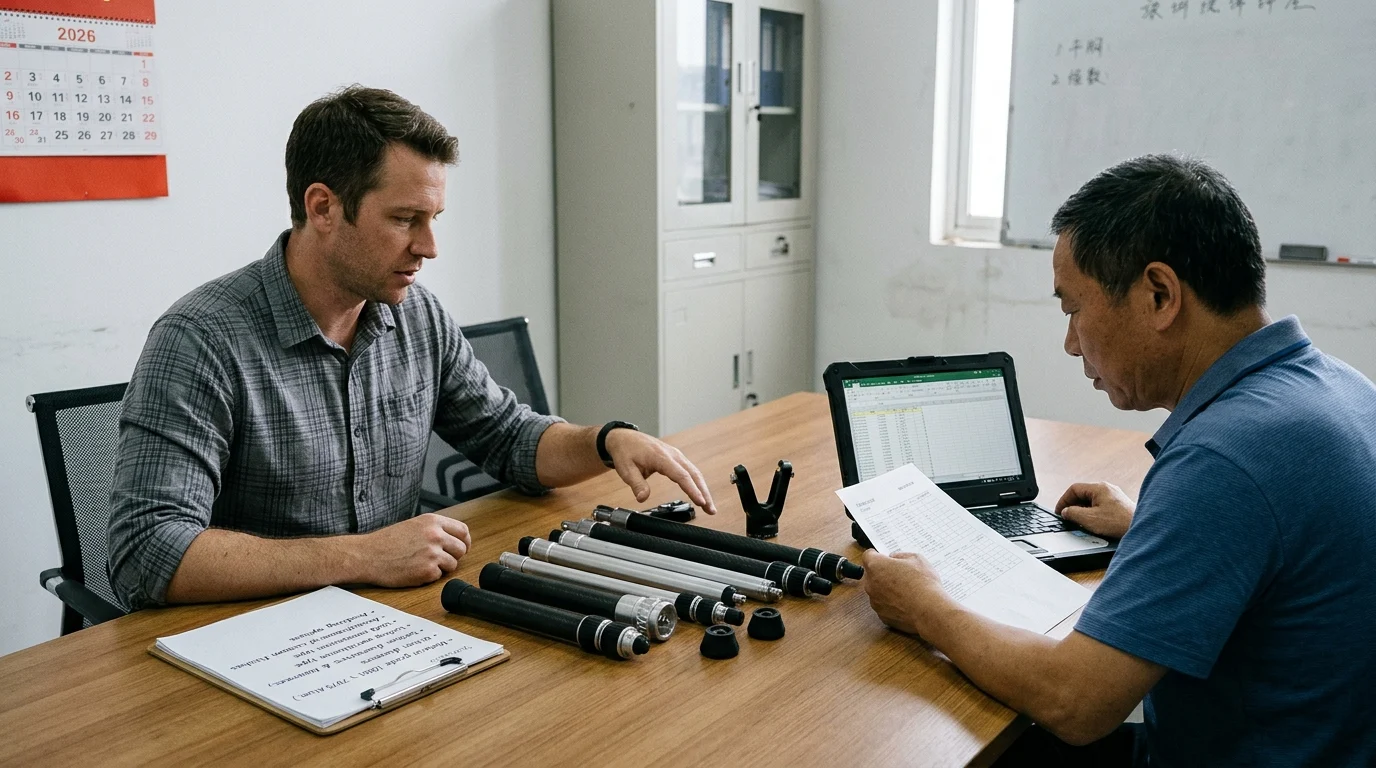
Not all design modifications are treated equally on the factory floor. Categorizing modifications based on how heavily they disrupt the supplier’s standard assembly line provides a direct correlation to the required purchasing volume.
Low-MOQ customization options such as logo and packaging
To keep minimums low, brands should focus on surface-level changes. Laser engraving a logo onto the leg shafts, silk-printing the EVA grips, or designing a custom corrugated color box are efficient options. Most reliable suppliers will gladly accommodate a private-label hunting stick order with these basic customizations at an accessible entry-level MOQ, adding only a minimal extension to the total production lead time (refer to the customization reference table below).
High-MOQ modifications such as materials, locks, and molds
Friction arises when altering the structural engineering. Changing the tube diameter from a standard 18mm to a custom 19mm, requesting a unique lever-lock mechanism, or demanding a specific aluminum 7075-T6 alloy grade requires the factory to source raw materials outside their usual supply chain. These structural changes almost always push MOQs into higher tiers and can extend lead times by several weeks while new extrusion molds are cut and tested. When investing in these new molds, it is a non-negotiable B2B procurement standard to establish clear mold ownership clauses and IP protection in the manufacturing contract before paying any tooling fees.
How to rank customization by cost, risk, and lead time
Evaluating these variables requires a systematic approach to balance strategic implications with decision logic. The table below serves as a quick-reference guide for how different customizations stack up in terms of cost, risk, and time, allowing importers to quickly align product strategy with budget constraints. (Note: The figures below are illustrative industry baselines; actual MOQs and lead times will vary by supplier and region.)
| Customization Type | Typical MOQ | Lead Time Impact | Cost/Risk Profile |
|---|---|---|---|
| Logo & Color Box | 300 – 500 | +1 to 2 weeks | Low Cost / Low Risk |
| Custom Foam Grips | 500 – 1,000 | +2 to 3 weeks | Low Cost / Medium Risk |
| Custom Cam Locks | 1,000 – 2,000 | +4 to 5 weeks | High Cost / Medium Risk |
| Proprietary V-Yoke | 1,500 – 3,000+ | +6 to 8 weeks | High Cost / High Risk |
How to negotiate MOQ without reducing product quality
Aggressive negotiations that force a factory into an unsustainably low minimum often result in shipments of defective products months later. Buyers can negotiate a manageable production MOQ, but it must be done strategically so the factory does not secretly cut corners to maintain profit margins. To manage risk on large OEM orders, always include procurement safeguards such as batch inspection rights and clear rejected-goods protocols in the purchasing agreement.
Use shared components and phased orders to lower MOQ
One of the most effective tactics is leveraging shared components. If a brand agrees to use the factory’s standard 20mm/18mm/16mm leg tubes and their existing twist-lock system, the supplier is much more likely to accept a lower MOQ on the overall order, even if the design features a custom wrist strap or yoke. Another strategy is the phased order: committing to a larger annual volume (e.g., 2,500 units) but taking delivery in smaller batches over several months. This provides the factory with the long-term volume they need while easing immediate cash flow constraints for the buyer. Mold-fee structures can also be negotiated so that tooling costs are amortized over these phased batches.
Avoid shortcuts in alloy grade, locking systems, and load capacity
If buyers push too hard on MOQ without offering concessions, factories might resort to unauthorized “value engineering.” Suppliers have been known to quietly swap aerospace-grade AL7075 for softer AL6061, or use cheaper ABS plastic in locking mechanisms instead of reinforced nylon. While basic models might cite an illustrative static load capacity of 50 to 100 lbs, buyers should avoid relying on unsupported weight benchmarks or arbitrary downward-pressure claims. Instead, always specify accepted testing standards (such as ASTM or ISO protocols) to verify load capacity. To enforce these specifications, buyers should require mill certificates for raw materials, mandate third-party lab testing (such as SGS or Bureau Veritas) before shipment, and include strict contract penalty clauses for unauthorized substitutions.
Sourcing, compliance, and logistics considerations
Once the product design is locked in, the macro picture comes into play. How the product is manufactured, packaged, and shipped dictates the final landed cost and the ability to sell legally in target markets.
How to compare suppliers by production capability
When evaluating factories, it is crucial to look beyond standard directory listings and assess actual production infrastructure. A supplier that handles CNC machining and aluminum anodizing in-house is generally more reliable than one that outsources these steps. Anodizing is a major bottleneck, and factories with in-house capabilities can often sustain a daily output of 1,500 to 2,000 units. It is important to note that this is a general estimate, as actual capacity varies heavily by facility size, equipment, and regional power constraints, but capable factories ensure orders avoid delays during peak sourcing seasons.
Compliance, labeling, and market requirements
Regulatory compliance is paramount when importing outdoor gear and hunting sticks. Looking toward 2026, evolving environmental regulations mean stricter scrutiny on materials. If selling into Europe, rubber and plastic components (like feet and yokes) must pass updated REACH testing for restricted chemicals. For the US market, particularly California, Prop 65 warning labels might be required depending on the chemical composition of grip materials. Because these obligations are complex, importers should always verify REACH, Prop 65, and other regulatory requirements with a certified compliance consultant rather than relying on self-service classifications. Keep in mind that compliance testing incurs additional costs and lead times, and failing to meet these standards can lead to inventory being seized at customs or costly legal liabilities.
Carton size, collapsible length, mixed models, and spare parts
Logistical efficiency is another critical factor. The collapsible length of the stick is a massive cost driver. Engineering a quad-stick or tripod to collapse to 60 cm instead of 65 cm optimizes carton cube efficiency. This reduction often keeps the master carton under critical dimensional-weight thresholds charged by freight forwarders, dramatically reducing volumetric shipping costs. It is also highly recommended to negotiate a standard allowance—such as 1% to 2%—for spare parts, specifically rubber ferrules and yoke fins, included in the same shipment. This handles future warranty claims efficiently without paying premium airfreight for tiny components later.
How to choose the right OEM customization level
Ultimately, the best manufacturing strategy depends entirely on the business model. There is no one-size-fits-all approach to customization, and knowing when to pull back is just as important as knowing when to invest in proprietary designs.
When private-label customization is enough
For Amazon FBA sellers or smaller distributors testing a new market, simplicity is key. Off-the-shelf models with proven track records are highly effective. Applying a brand logo to high-quality standardized off-the-shelf models using existing factory molds allows businesses to go to market in under 45 days with minimal capital tied up in inventory. For many companies, private labeling is more than enough to establish a profitable foothold.
Decision framework for distributors, Amazon sellers, and brands
For established brands aiming for retail shelf space, proprietary features are necessary to justify higher price points and defend against knock-offs. The decision matrix below provides a strategic overview to align business types with the right OEM or ODM strategy, serving as a quick reference for the next procurement cycle:
| Buyer Profile | Recommended Strategy | Customization Level | Target MOQ |
|---|---|---|---|
| Amazon/E-com Startup | Private Label | Logo, custom box, standard specs | 300 – 500 |
| Regional Distributor | Minor OEM / ODM | Custom grips, unique colors | 500 – 1,000 |
| Established Brand | Full OEM / ODM | Proprietary molds, custom locks | 1,500 – 3,000+ |
| Big Box Retailer | High-Volume OEM | Exclusive designs, strict compliance | 5,000+ |
Ultimately, successfully importing hunting sticks requires balancing upfront customization costs with long-term market positioning. By clearly defining your OEM or ODM requirements, verifying compliance with certified professionals, and strategically negotiating MOQs through shared components or phased orders, you can build a resilient supply chain. Use the frameworks above to guide your next supplier conversation and ensure your 2026 product line launches smoothly and profitably.
Key Takeaways
- Start with logo, grip, and packaging customization if you want to keep an OEM hunting stick MOQ near entry-level volumes such as 300 units.
- Budget for higher MOQs of 1,500 to 2,000 units when using proprietary yokes, premium carbon fiber, or non-standard raw materials.
- Clarify whether the supplier defines your project as white-label, ODM modification, or full OEM before comparing quotations.
- Plan tooling costs early, as a custom injection mold for a specialized yoke can cost about $2,500 to $5,000 depending on complexity.
- Use a written sample approval process and consider a 50/50 tooling deposit structure before moving into mass production.
- Confirm HS code classification and Incoterms such as FOB or EXW before ordering to avoid inaccurate landed-cost calculations.
Frequently Asked Questions
What is a typical MOQ for a basic OEM hunting stick order?
For standard models such as an aluminum 6061 bipod, importers may see MOQs around 300 units, especially when customization is limited to logo, grip printing, or packaging.
Why does carbon fiber customization increase MOQ?
Premium carbon fiber, especially 8-layer material, often requires non-standard sourcing and production setup. Suppliers may raise MOQs to justify material minimums, machine configuration, and added quality control.
How much can custom tooling cost for a shooting stick component?
A custom plastic injection mold for a proprietary yoke may cost roughly $2,500 to $5,000, depending on design complexity, labor region, tolerances, and mold structure.
What is the difference between OEM and ODM for hunting sticks?
OEM usually means the factory builds to your design, specifications, and IP. ODM means you select and modify the factory’s existing design, which is often faster and lower cost.
Which customizations usually keep MOQ low?
Low-MOQ options include laser-engraved logos, silk-printed EVA grips, private-label packaging, hang tags, and color box design because they do not heavily disrupt the supplier’s production line.
Post time: Nov-18-2026