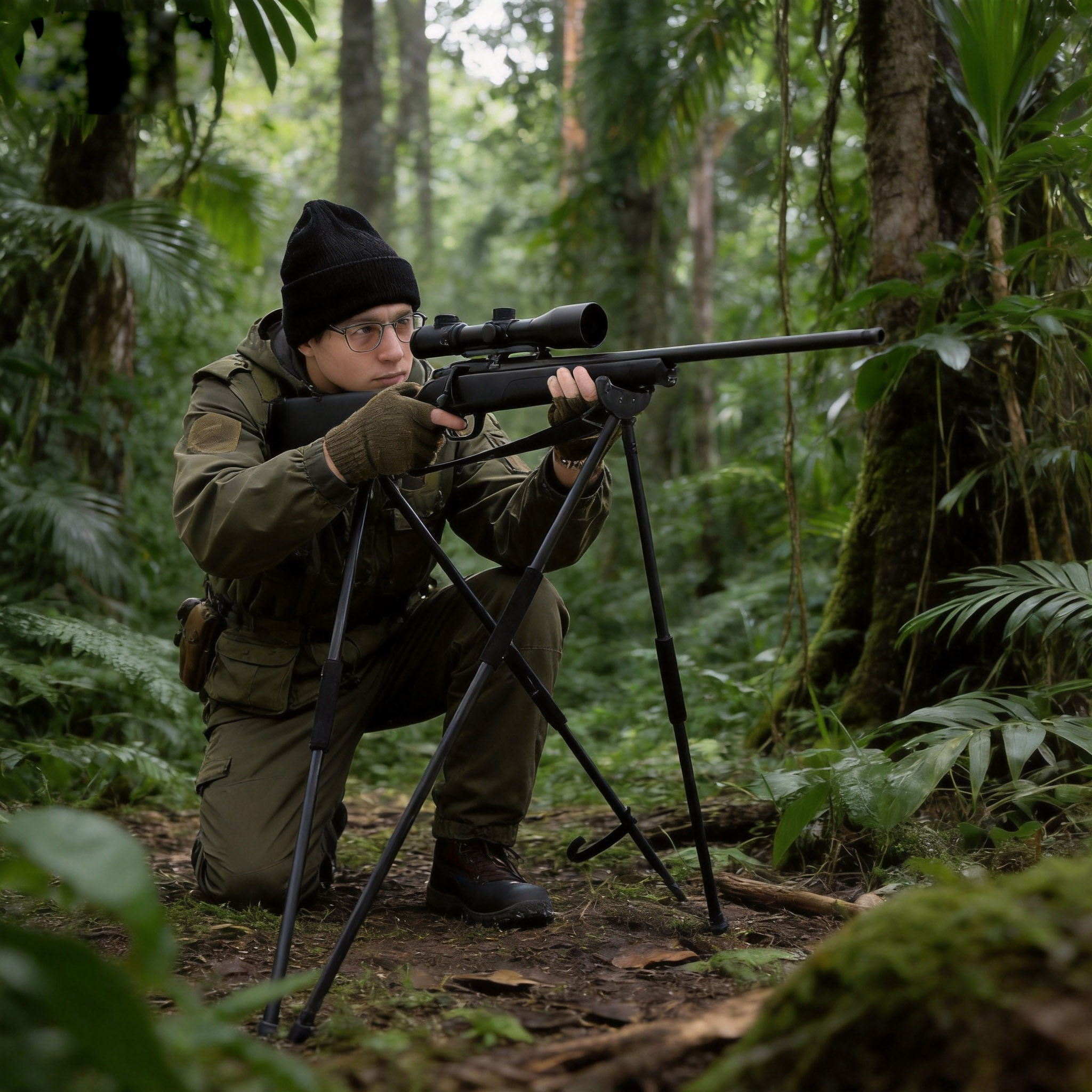
 A profitable bulk order can turn into a costly returns problem if the supplier behind it cannot control tolerances, materials, or final inspection. For distributors, sourcing wholesale shooting sticks means balancing FOB price, defect risk, MOQ, and the expectations of hunters in different markets. Entry-level aluminum bipods and premium carbon fiber quad-sticks may both look attractive in a catalog, but they require very different manufacturing standards and cost models. This guide explains how to define buying goals, verify whether a supplier is a real shooting stick manufacturer, and compare product specifications before placing a container-sized order.
Why Wholesale Shooting Sticks Need Careful Supplier Evaluation
If you have ever unboxed a container of outdoor gear only to find rattling joints and snapped yokes, you already know the stakes. Sourcing wholesale shooting sticks isn’t just about finding the lowest price on a B2B platform; it’s about protecting your brand’s reputation and your bottom line. Distributors have been known to lose thousands of dollars in returns because they skipped the vetting process and trusted a shiny catalog over hard data.
When you’re dealing with bulk orders, your margin of error shrinks. A standard acceptable defect rate in this industry typically hovers below 1.5%. Anything higher, and customer service costs can quickly wipe out profit margins. Finding a reliable shooting stick manufacturer requires looking past the sales pitch and digging into their actual production capabilities.
How to Define Your Wholesale Buying Goals
Before reaching out to suppliers, it is crucial to nail down exactly what you are trying to buy. Target audiences dictate product requirements—budget-conscious weekend hunters need entirely different gear than premium, backcountry precision shooters. Furthermore, regional market variability plays a major role; a product specced for the US or EU market may be over-engineered and priced out of domestic or emerging markets.
For entry-level markets, buyers might look for basic aluminum bipods with an initial target FOB price of $10 to $15 per unit and a minimum order quantity (MOQ) of 1,000 pieces. Conversely, high-end markets demand carbon fiber quad-sticks that might cost $45 to $70 FOB. Establishing target landed costs, volume requirements, and regional expectations upfront prevents wasted time negotiating with factories that cannot meet specific price bands or scale.
What Distributors Should Confirm Before Comparing Suppliers
A best practice is to act like an auditor before acting like a buyer. The first detail to verify is whether the business is a true manufacturer or a trading company. Request their business license and check their registered capital; as one benchmark, a factory producing heavy-duty aluminum and carbon fiber goods will often have a registered capital of around $500,000 USD.
Next, confirm their export history by asking which markets they currently ship to. If importing to strictly regulated regions, a supplier who already understands those quality expectations is essential. Finally, request their standard ISO 9001 certification. While a certificate doesn’t guarantee perfection, it proves they have a baseline quality management system in place for handling bulk runs.
Key Product Specifications to Compare
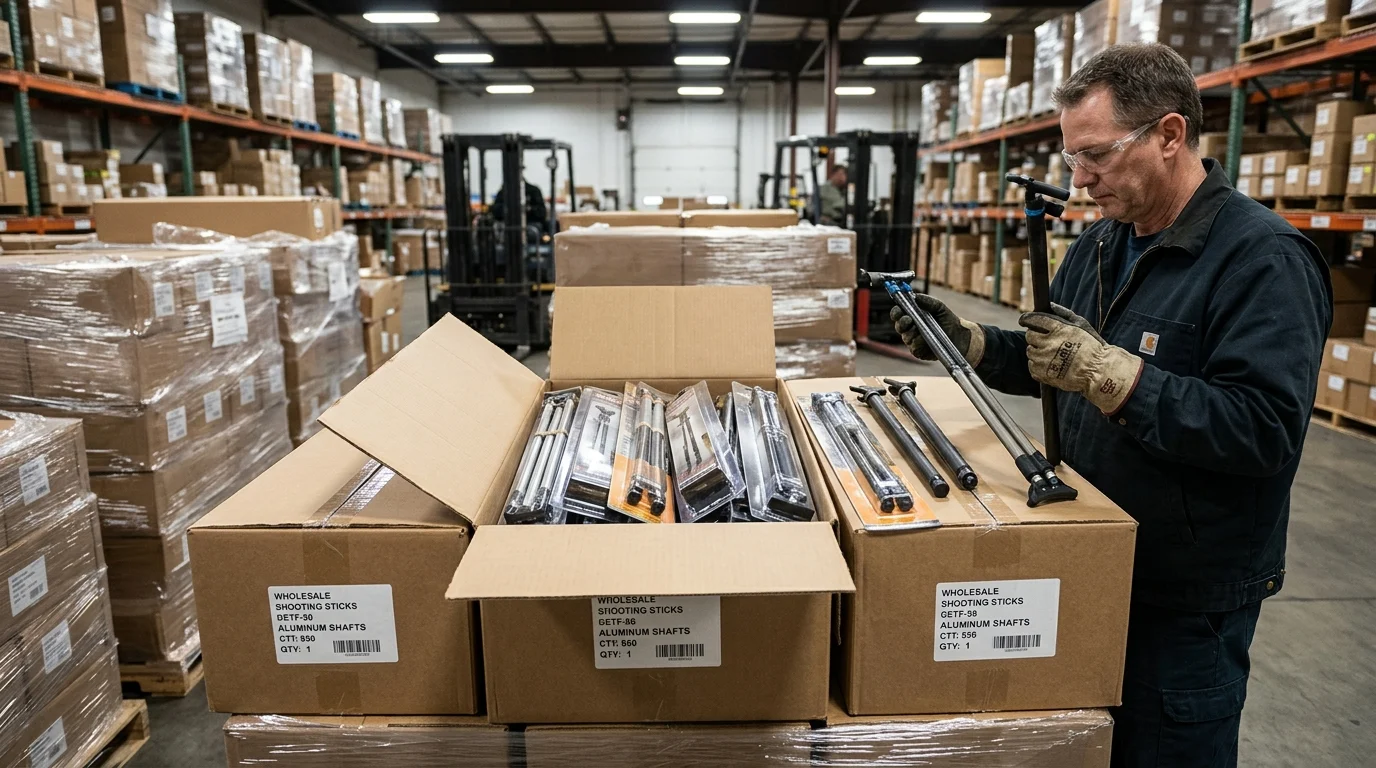
Once a shortlist of potential partners is established, it is time to get granular with the product itself. A shooting stick is essentially a portable stabilization system, and it is only as strong as its weakest joint. Comparing apples to apples is necessary when evaluating specifications.
Materials, Locks, Leg Design, and Shooting Heads
The core of any shooting stick is the tube material. Most suppliers offer 6061 aluminum as the standard, which is suitable for budget models. However, for a premium feel and better strength-to-weight ratio, buyers should look for 7075 aerospace-grade aluminum or 8-layer carbon fiber. The wall thickness of the tubes should ideally be between 1.0mm and 1.2mm to prevent bending under pressure.
Locks and leg designs are where lower-tier sticks often fail. Compare twist locks versus flip locks; a high-quality flip lock should withstand at least 15 to 20 kg of vertical pressure without slipping. For shooting heads, check if the V-yoke is made of basic hard plastic or if it utilizes TPR (Thermoplastic Rubber) overmolding for better grip and quietness in the field.
Durability, Stability, and Field-Use Testing
Gear must survive the elements to be viable for hunters. Distributors should request internal testing data from suppliers. Do they perform a 48-hour salt spray test on metal components to ensure corrosion resistance? Do they conduct drop tests from 1.5 meters to ensure plastic leg joints won’t shatter in freezing weather?
Stability testing is equally critical, especially for tripods and quad-sticks. The manufacturer should be able to provide load-bearing certificates proving the deployed stick can hold at least 25 kg of static weight without the legs bowing or the central hub cracking.
Specification Tables for Supplier Comparison
To keep evaluations organized, building a matrix is highly recommended. When sourcing wholesale shooting sticks, having a side-by-side view of what each factory offers makes the decision process much clearer.
| Feature/Spec | Budget Tier (Typical) | Premium Tier (Target) | Minimum Standard to Accept |
|---|---|---|---|
| Tube Material | 6061 Aluminum | Carbon Fiber / 7075 Alu | 1.0mm wall thickness |
| Lock Type | Basic Twist Lock | Adjustable Flip Lock | 15 kg vertical hold force |
| Yoke Material | Hard ABS Plastic | Overmolded TPR / Silicone | Non-slip, weather-resistant material |
| Weight | 1.2 – 1.5 kg | 0.8 – 1.0 kg | Under 1.5 kg for portability |
| Est. FOB Price | $12 – $18 | $45 – $75 | Varies by volume |
How to Assess Manufacturing Capability
A great prototype doesn’t mean much if the factory cannot replicate it consistently at scale. Assessing manufacturing capability separates professional operations from amateurs, revealing exactly how goods will be handled from raw materials to final carton packing.
Factory Evidence and Production Capacity
If visiting the factory in person isn’t possible, demand a live video tour. Look for organized assembly lines, proper safety gear, and clear segregation of raw materials from finished goods. Ask about monthly production capacity; a mid-sized factory can often comfortably produce 30,000 to 50,000 units a month.
Verify their equipment rather than relying solely on claims. CNC machines for aluminum heads and dedicated injection molding machines for plastic clips are strong indicators that they control their own production rather than outsourcing vital components to third-party workshops.
OEM, Private Label, Packaging, and Accessory Options
Most distributors prefer proprietary branding over off-the-shelf white-label items. Evaluate the supplier’s OEM and private label capabilities. If a custom mold is required for a proprietary yoke design, tooling costs typically range from $2,000 to $5,000 USD depending on complexity.
Packaging is another major factor. Standard brown boxes might have a low MOQ, but full-color retail packaging usually requires an MOQ of 1,000 to 2,000 units just for the boxes. Additionally, inquire about accessory options—such as bundling carrying bags, extra rubber feet, or snow baskets directly on the assembly line.
Inspection Checkpoints from Samples to Shipment
Quality control requires established inspection checkpoints. It is standard practice to specify an AQL (Acceptable Quality Limit) in contracts—commonly AQL 2.5 for major defects (like a broken lock) and 4.0 for minor defects (like a small scratch on the paint).
Hiring a third-party inspection company to check the goods before paying the final balance is highly recommended. They should pull a random sample from the finished batch to test leg deployment, yoke rotation, and packaging integrity. If the failure rate exceeds the AQL threshold, the factory must rework the batch at their own expense.
Compliance, Logistics, and Landed Cost Factors
Manufacturing the product is only part of the process. Ensuring compliance, managing shipping, and landing inventory without unexpected costs are where margins are protected. Poorly managed logistics and compliance can easily add 20% to 30% to the final unit cost.
Labeling, Materials, and Packaging Requirements
Depending on the region, shooting sticks might fall under specific consumer safety and material regulations. For EU imports, rubber components (like grips or yokes) generally need to be REACH compliant to ensure they lack hazardous chemicals. For the US market, particularly California, Prop 65 compliance is necessary to avoid fines.
Packaging materials also impact logistics. Suppliers should use double-corrugated export cartons (usually 5-ply). Many buyers mandate that master cartons pass an ISTA 1A drop test, simulating the rough handling boxes endure during sea freight and final-mile delivery.
FOB, EXW, MOQ, Lead Time, and Payment Terms
While target prices and volumes are set early on, finalizing Incoterms and MOQs in the contract is non-negotiable. Many distributors prefer FOB (Free On Board) terms, meaning the supplier covers the cost of getting goods to the nearest port and cleared for export. With EXW (Ex Works), the buyer pays for trucking from the factory to the port, adding to the landed cost.
When partnering with a B2B shooting stick supplier, standard payment terms are often a 30% deposit upfront and 70% against the Bill of Lading (B/L) or after passing third-party inspection. Standard lead times run about 35 to 45 days, but during peak hunting season prep, this can stretch to 60 days.
Order Steps That Reduce Production Delays
To avoid production delays, map out every milestone with the supplier. Approve a ‘golden sample’ before mass production begins, and have them sign and date it. This becomes the undeniable standard for the order.
| Shipping Mode | Avg. Transit Time (to US/EU) | Cost Relative to Value | Best Used For |
|---|---|---|---|
| Sea Freight (FCL) | 25 – 40 Days | Lowest ($) | Standard bulk replenishment |
| Sea Freight (LCL) | 30 – 45 Days | Medium ($$) | Smaller runs (under 15 CBM) |
| Air Freight | 5 – 10 Days | Extremely High ($$$$) | Emergency restocking only |
| Express Courier | 3 – 7 Days | Highest ($$$$$) | Samples and prototypes |
How to Choose the Right Shooting Stick Manufacturer
Picking a manufacturer is a balancing act. The goal is to find a partner capable of growing alongside a distribution business, rather than just providing a one-time cheap price. Experienced buyers often walk away from incredibly low quotes if a supplier’s communication proves unreliable.
Balancing Price, Quality, Service, and Reliability
Distributors must balance the classic quad of price, quality, service, and reliability. Saving a small amount per unit on bulk order hunting sticks is rarely worth it if the factory delays a shipment by four weeks, causing missed seasonal sales.
Pay close attention to how quickly and clearly they respond to inquiries. Do they point out potential flaws in a custom design, or do they just agree to everything? A reliable manufacturer will push back if a requested specification compromises the product’s durability.
Supplier Scoring for Wholesale Shooting Sticks
To take emotion out of the decision, using a weighted supplier scorecard is an effective method. A common breakdown assigns 40% of the score to product quality (based on samples and specs), 30% to pricing and terms, 20% to communication and service, and 10% to production capacity and lead time.
Scoring top suppliers against this matrix forces a look at the big picture rather than just the bottom line on a quotation sheet. The supplier that scores the highest across the board is usually the safest bet for a long-term partnership.
Final Checklist Before Signing an Order
Before wiring a deposit, ensure the Proforma Invoice (PI) is comprehensive. It should explicitly list materials, colors, weights, packaging details, and the agreed-upon lead time. It is also common to negotiate a penalty clause for late delivery, such as a 1% to 2% deduction from the final balance for every week a shipment is delayed past the agreed date.
Finally, mitigate first-order risk by starting with a smaller pilot run before committing to a massive container load. A pilot order tests the manufacturer’s quality control and logistical reliability under real-world conditions. Once the PI is signed, the sample is approved, and the pilot terms are locked, distributors can confidently initiate the partnership and prepare their warehouse for new inventory.
Key Takeaways
- Set target FOB price, landed cost, order volume, and regional market requirements before contacting any shooting stick manufacturer.
- Keep bulk-order defect rates below 1.5% to protect margins from returns, replacements, and customer service costs.
- Verify business licenses, registered capital, export history, and ISO 9001 certification before treating a supplier as a qualified manufacturer.
- Compare entry-level aluminum bipods and premium carbon fiber quad-sticks separately because their expected FOB ranges and buyers differ significantly.
- Evaluate locks, joints, tube materials, leg design, and shooting heads with samples before committing to a wholesale production run.
Frequently Asked Questions
What should distributors verify before ordering wholesale shooting sticks?
Confirm whether the supplier is a true manufacturer, review their business license, check export experience, request ISO 9001 certification, and inspect sample quality before discussing bulk pricing.
What is an acceptable defect rate for bulk shooting stick orders?
A practical benchmark is below 1.5%. Higher defect rates can quickly erode margins through returns, replacements, customer service costs, and damage to distributor reputation.
Which materials are common in shooting stick manufacturing?
6061 aluminum is common for value-focused models, while carbon fiber is preferred for premium lightweight shooting sticks. The right choice depends on target market, price band, and performance expectations.
How much do wholesale shooting sticks typically cost?
Entry-level aluminum bipods may target about $10 to $15 FOB per unit, while premium carbon fiber quad-sticks can range from roughly $45 to $70 FOB, depending on specifications and order volume.
Why is MOQ important when comparing shooting stick manufacturers?
MOQ affects cash flow, landed cost, and supplier fit. For example, budget models may require around 1,000 pieces, so distributors should confirm volume requirements before sample development.
Post time: Oct-08-2026