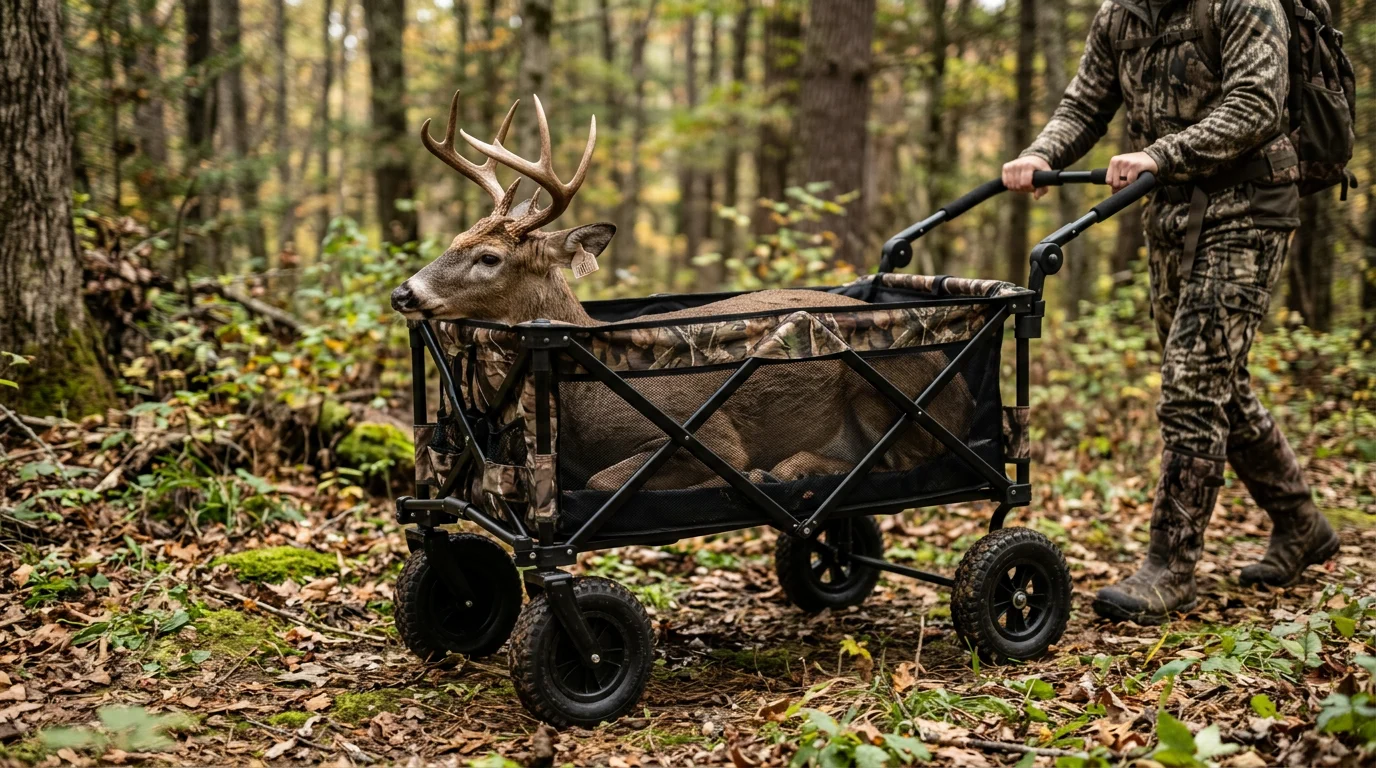
Getting a deer down is only half the job; getting it out cleanly, safely, and before heat damages the meat is where the right transport system proves its value. A modern folding game carrier, compact folding game bag, or rugged wild transport bag can reduce back strain, improve load control, and keep venison away from dirt and ground heat. This guide breaks down how these systems work, when each style makes sense, and what features matter most for real hunting conditions—from solo public-land pack-outs to warm-weather archery hunts where every minute of cooling counts.
Understanding Deer Folding Game Carriers
I’ve hauled my fair share of whitetail and mule deer out of steep ravines, and if there’s one thing I’ve learned, it’s that your back is your most valuable asset. Relying on sheer willpower and a drag rope might work in your twenties, but it’s a recipe for disaster—and spoiled meat—as you get older. That’s exactly why a reliable folding game carrier has become a non-negotiable part of my kit. When we talk about modern game transport, the evolution from clunky, rigid wheelbarrows to highly packable, foldable systems is nothing short of revolutionary.
We’re looking at gear that stows away cleanly in a daypack but deploys to handle massive loads when the real work begins. Whether you are a solo backcountry hunter pushing miles past the trailhead or an outfitter looking to streamline client harvests, understanding the mechanics of these folding carriers is critical before your next hunt.
What is a deer folding game carrier
?
At its core, a folding game carrier is a collapsible transport system engineered to move harvested game from the field to the cooler with minimal physical strain. Unlike traditional rigid carts, these carriers generally fall into three distinct categories: soft folding slings (stretcher-style carriers requiring two operators), wheeled folding carts (collapsible frames with removable wheels for solo use), and heavy-duty meat haulers (reinforced backpack-style bags). They often utilize hinged frames crafted from lightweight aluminum or carbon fiber composites, paired with heavy-duty fabric.
The primary function isn’t just carrying weight; it’s about weight distribution and meat preservation. A good carrier keeps the animal off the ground, reducing friction and preventing dirt, debris, and ground heat from compromising the meat. Some models integrate wheels that pop on and off via quick-release pins, while others function more like a structured, two-person stretcher or a highly reinforced folding game sling that distributes a heavy load ergonomically across your shoulders and hips.
When should hunters use a folding game carrier
?
I recommend deploying a folding carrier anytime your harvest is more than a mile from your vehicle, especially in areas where motorized retrieval via ATV or UTV is legally prohibited or geographically impossible. If you’re hunting public land, you already know the drill: the further you get from the trailhead, the better the hunting, but the brutal reality of the pack-out looms over every trigger pull. A folding system shines in these deep-woods scenarios because you don't have to drag it loudly through the brush while hunting; it stays silent and out of the way until you need it.
Furthermore, they are absolute lifesavers in early-season archery hunts when temperatures are hovering above 60°F (15°C). Dragging a deer on the ground exposes the meat to dirt abrasion, hair slip, and contamination. Additionally, leaving a carcass flat on the ground traps body heat and accelerates bacterial growth. Elevating the carcass on a breathable carrier allows for 360-degree airflow, dropping the meat's temperature rapidly. If you’re crossing blowdowns, navigating swampy terrain, or side-hilling across scree fields, a compact folding carrier gives you the maneuverability that a standard wheeled cart completely lacks.
What are the main trade-offs between budget and premium
options?
When you start shopping, you’ll immediately notice a massive price gap. Budget carriers typically run between $40 and $80. For that price, you’re usually getting powder-coated steel frames and lighter 300-denier polyester fabric. The trade-off here is weight and longevity. Steel rusts if the coating chips, and a steel frame can easily push the carrier’s empty weight past 10 or 12 pounds. The lighter fabric might hold up for a season or two of light whitetail hauling, but push a heavy buck over a sharp rock, and you’re looking at a blown seam or a massive tear.
On the flip side, premium models ranging from $150 to over $300 are an investment in your own endurance. These units feature aircraft-grade aluminum or carbon fiber frames, dropping the weight down significantly. The fabrics upgrade to heavier nylon with polyurethane coatings for blood and water resistance. You also get better hardware—think stainless steel locking pins instead of cheap plastic clips. If you’re an outfitter or a die-hard hunter logging 20+ days a season, the premium option pays for itself by not failing when you’re three miles deep in the backcountry.
Key Specifications to Compare
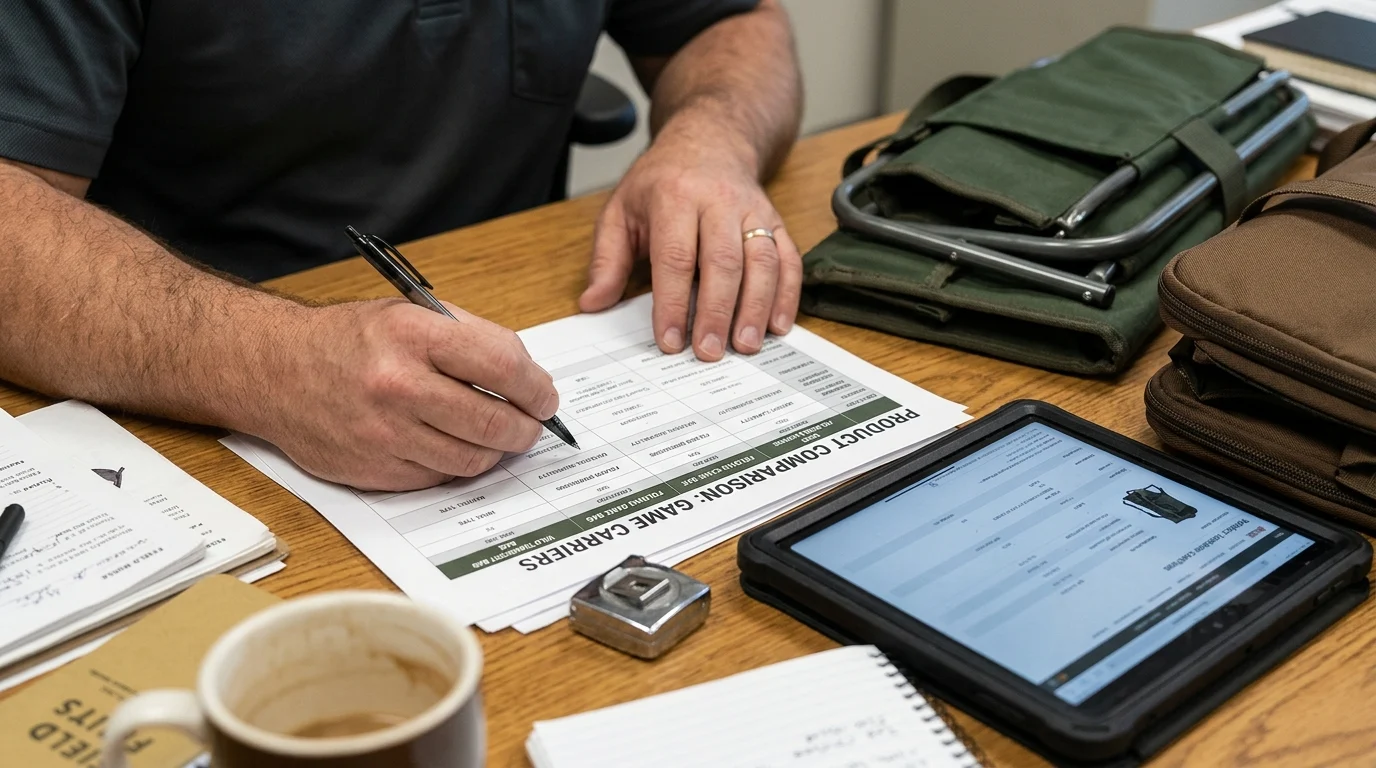
Specs matter when you're staring down a steep ravine with 150 pounds of venison at your feet. You can't rely on marketing fluff when the physical limits of your gear are put to the test. Let's break down the actual numbers and material science you need to look for.
I always tell hunters to treat their game carrier like they treat their boots or their optics. You need to look under the hood at the fabric ratings, the tensile strength of the stitching, and the specific alloys used in the frame. Here is exactly what I compare when evaluating a new carrier.
How much load capacity do you need
?
Load capacity is the most critical metric. Standard folding bags and light carriers usually handle between 100 and 150 lbs, which is perfectly fine if you are quartering your game in the field and packing out meat, bone, and cape in trips. However, if your strategy involves hauling a whole dressed whitetail or multiple heavy elk quarters in a single go, you need a heavy-duty carrier rated for 250 to 300 lbs.
Keep in mind that dynamic load is different from static load. A carrier might hold 250 lbs standing still in a garage, but when you are bouncing it over logs and rocks, the dynamic stress multiplies. I always look for a carrier that has a stated capacity at least 30% higher than the maximum weight I actually plan to haul. If I know I'm hauling 150 lbs of meat, I want a frame rated for at least 200 lbs to prevent catastrophic failure.
Which materials, stitching, and waterproofing features matter
?
The fabric of the carrier acts as the hammock for your harvest, and denier (D) is the measurement of the yarn's thickness. I consider 600D nylon to be the absolute bare minimum for a reliable folding game bag, but 1000D is the gold standard for resisting punctures from broken ribs or sharp sticks.
| Feature | Budget Tier | Premium Tier | Ideal Spec |
|---|---|---|---|
| Fabric Denier | 300D Polyester | 1000D Nylon | 600D – 1000D |
| Waterproofing | None / Light DWR | PU Coated | >2000mm Hydrostatic Head |
| Stitching | Single Stitched | Triple Stitched | Bar-tacked at stress points |
| Thread Type | Standard Cotton/Poly | Bonded Nylon | Heavy-duty Bonded Nylon |
Waterproofing is another vital spec, not just to keep rain off, but to keep blood from soaking into the fibers and breeding bacteria. Look for an inner coating with a high hydrostatic head rating. As for stitching, if the seams aren't double or triple-stitched with heavy-duty bonded nylon thread, and bar-tacked at the handles and frame joints, walk away. A heavy-duty fabric means nothing if the thread holding it together snaps under a heavy load.
How do frames, handles, zippers, buckles, and wheels affect
performance?
The skeleton of your carrier dictates how it handles the abuse of the trail. If you are looking at wheeled folding carriers, the frame should be constructed from high-grade aluminum tubing to offer an incredible strength-to-weight ratio. The wheels themselves need to be puncture-proof—solid polyurethane tires are ideal—and large enough to roll over obstacles. A larger wheel diameter, often around 14 to 16 inches, tends to be the sweet spot; anything smaller will sink into mud or get hung up on roots.
For soft-sided folding carriers and transport bags, pay close attention to the handles and hardware. Zippers should be oversized, specifically YKK #10 or equivalent, with self-healing coil designs to handle dirt and grime. Buckles should be made of acetal polymer or machined aluminum, as standard nylon buckles become brittle and shatter when temperatures drop below freezing. Six strategically placed handle loops made from 2-inch tubular webbing will allow you and a buddy to navigate tight timber much easier than a single top-and-bottom handle setup.
Choosing the Right Carrier for Your Hunt
No single carrier works perfectly for every hunt. I tailor my transport gear to the specific environment I’m heading into. What works flawlessly in the flat, open timber of the Midwest will be an absolute nightmare in the vertical, rocky scree of the Rockies.
Choosing the right setup means analyzing your typical hunting environment, the size of the game you pursue, and how the carrier integrates with the rest of your gear system.
How do terrain, climate, and game size affect your
choice?
Terrain dictates everything. If you are hunting in high-humidity, swampy environments, breathability and elevation are your main concerns. You need a carrier with heavy-duty mesh panels that allow ample airflow to prevent meat spoilage. Conversely, if you are dragging through snow and freezing mud, a solid, slick-bottomed coated bag is superior because it glides over the surface.
Game size also plays a massive role. A mature Midwestern whitetail buck might dress out at 180 lbs, which fits perfectly into a standard folding carrier. But if you are chasing elk, where a single hind quarter can weigh 60 to 80 lbs, you need a modular system. In those cases, a reinforced meat hauler that can be strapped tightly to a rigid external pack frame is far more effective than trying to maneuver a wheeled cart through dark timber.
When is a folding carrier better than a sled
, cart, or pack?
I frequently get asked when a folding carrier is actually better than a traditional sled, a rigid game cart, or just stuffing meat into a hunting pack. It is worth noting that for remote, off-trail backcountry hunts—particularly for large game like elk or moose—most experienced hunters opt to quarter the animal and rely on dedicated internal-frame meat packs. Folding slings and carts are generally better suited for moderate distances or less vertical terrain.
| Transport Type | Best Terrain | Empty Weight | Packability Volume |
|---|---|---|---|
| Rigid Game Cart | Logging roads, flat trails | 15 – 25 lbs | Poor (Stays at truck) |
| Plastic Sled | Snow, marsh grass | 5 – 10 lbs | Fair (Straps to outside) |
| Internal Frame Pack | Steep, vertical, thick brush | 4 – 7 lbs | Excellent (Worn on back) |
| Folding Carrier / Bag | Mixed timber, moderate hills | 2 – 5 lbs | Excellent (< 5 Liters rolled) |
Sleds drag beautifully on snow but act like sandpaper on dry rocks, wearing through quickly. Rigid carts are amazing on logging roads but have a nasty habit of flipping over on sidehills, often taking your harvest down the mountain. A folding carrier bridges the gap. It imposes virtually zero weight penalty and takes up minimal space in a standard daypack, meaning you always have it with you when the shot breaks.
What comparison criteria should you use before buying
?
Before you hit the checkout button, establish your personal comparison criteria. First, evaluate the weight-to-capacity ratio. A highly efficient carrier will support a substantial load while adding minimal weight to your pack. If a carrier weighs 10 lbs but only supports 150 lbs, its efficiency ratio is poor compared to modern ultralight alternatives.
Second, evaluate the deployment time. Can you unfold and assemble the carrier in under 60 seconds with cold hands or while wearing gloves? Pin-and-lock systems should be tethered so you don't lose small parts in the snow. Finally, check the washability. You want a material that can be hosed off and sterilized with a mild bleach solution without degrading the fabric or hardware over time.
Sourcing, Quality, and Logistics Checks
While solo hunters buy one rig at a time, I often consult for outfitters buying in bulk, hunting clubs, or retailers stocking up for the fall season. For them, the supply chain and logistics side of a folding game carrier is just as critical as its field performance.
Sourcing high-quality gear at scale requires looking past the glossy catalog photos and demanding hard data from manufacturers. The difference between a profitable retail season and a nightmare of customer returns comes down to strict quality control and smart logistics planning.
How can you verify material quality and seam strength
?
When dealing with overseas manufacturers, never take "heavy duty" at face value. I always advise commercial buyers to request formal tensile strength test reports for the fabrics being used. This test determines the maximum force the fabric can withstand before tearing. For a premium game carrier, general industry benchmarks look for high tensile strengths to ensure the fabric won't fail under dynamic loads.
Seam strength is equally important. Request samples and physically inspect the stress points. The junctions where the handles meet the main body of the carrier should feature box-X stitching or dense bar-tacking. If you are ordering custom runs, specify that the factory must use bonded nylon thread rather than cheaper polyester threads, which degrade quickly under UV exposure and heavy strain.
What packaging, labeling
, and sanitation requirements should you review?
Because these products come into direct contact with raw meat intended for human consumption, sanitation standards are paramount. If the carrier includes a waterproof lining, verify that the manufacturer is using food-grade materials rather than cheap PVC, which can off-gas and taint the meat. Labeling should clearly indicate cleaning instructions, emphasizing cold water washes and avoiding high-heat machine drying that destroys waterproof membranes.
From a packaging standpoint, request vacuum-sealed or tightly compressed roll-packing from your supplier. Because folding carriers are inherently flexible, vacuum sealing can reduce the shipping volume significantly. This drastic reduction in dimensional weight directly translates to lower freight costs and more efficient warehouse storage once the product lands.
How do landed cost, MOQ, freight, and replacement parts
affect value?
Understanding the unit economics is crucial for bulk buyers. Minimum Order Quantities (MOQs) for custom-branded folding carriers often require bulk commitments of several hundred units, though off-the-shelf white-label designs might lower that requirement. For a solid mid-tier bag featuring quality fabric and aluminum hardware, estimated landed costs (manufacturing, freight, and duties) can vary widely based on market conditions, but volume orders typically secure significant discounts.
Keep freight times in mind. Sea freight can add several weeks to your lead time, so orders for the September archery season need to be finalized by early spring. Finally, always negotiate a spare parts inclusion in your contract—extra quick-release pins, replacement buckles, and patch kits. Offering these replacement parts to your retail customers or guides builds massive brand loyalty and prevents full-unit returns over a simple broken buckle.
Final Buying Decision
It’s time to pull the trigger on a decision. I've spent thousands of dollars testing gear in the brush, mud, and snow so you don't have to learn these lessons the hard way.
Whether you are buying a single carrier for your own weekend hunts or outfitting an entire commercial lodge, making the final choice comes down to aligning the specs we've discussed with your specific reality on the ground.
What step-by-step process should guide your selection
?
I recommend a simple four-step process to guide your selection. First, assess your average haul distance. If you rarely shoot an animal more than 500 yards from a logging road, a heavier, wheeled carrier is perfectly fine. If you are packing in 3 miles, you need a soft-sided folding sling. Second, determine your typical load weight. Whitetail hunters can get away with 150 lb capacities, while elk hunters need heavy-duty options capable of handling much more.
Third, check pack compatibility. Measure the external lashing points on your current hunting backpack and ensure the folded dimensions of the carrier will strap on securely without throwing off your center of gravity. Finally, set your budget, keeping in mind that spending a little extra now will likely save you from buying a replacement carrier next season.
Which carrier fits solo hunters, outfitters
, and commercial buyers?
The ideal carrier profile shifts dramatically depending on the user. For the solo backcountry hunter, weight is the absolute enemy. You should look for an ultralight, frameless folding bag that weighs under 2 lbs, relying on your internal frame pack to provide the rigidity once the meat is loaded.
Outfitters and commercial lodge owners have different priorities. When your guides are hauling game for clients every single day for three months straight, durability and washability trump weight. Commercial buyers should target carriers that feature indestructible materials, reinforced tubular webbing, and easy-to-sterilize surfaces. A guide doesn't mind a slightly heavier carrier in the truck if it means it won't blow a seam mid-season.
How should you balance durability, portability, and price
?
Finding the ultimate sweet spot requires balancing durability, portability, and price. For the vast majority of hunters, I've found that the best value lies in a mid-to-heavyweight nylon carrier with a minimalist aluminum stay system. It isn't the absolute lightest on the market, nor is it the cheapest, but it hits the perfect middle ground.
At that price point, you are getting a piece of gear that will easily provide years of heavy use. It will fold down small enough to stay out of your way during the stalk, but it will deploy into a rugged, reliable tool when you have heavy venison to move. Invest in the right carrier, take care of the materials, and your back will thank you on every single pack-out.
相关阅读:Wild Transport Bag
Key Takeaways
- Choose a folding game carrier when your harvest is more than a mile from the vehicle or when ATV and UTV access is not allowed.
- Use a carrier that keeps the deer off the ground to reduce dirt, debris, friction, and heat buildup around the meat.
- Pick wheeled folding carts for solo pack-outs on passable trails, and choose slings or reinforced bags for steep, brushy, or uneven terrain.
- In warm early-season hunts above 60°F or 15°C, prioritize fast meat cooling by elevating the carcass and improving airflow.
- Look for lightweight frames, heavy-duty fabric, secure straps, and quick-deploy features so the carrier packs quietly but handles serious loads.
Frequently Asked Questions
What is the main advantage of a folding game carrier for deer hunting?
A folding game carrier helps move harvested deer with less strain by improving weight distribution, keeping meat off the ground, and reducing contamination from dirt, leaves, and debris.
When should I use a folding game carrier instead of a drag rope?
Use one when the deer is more than a mile from your vehicle, terrain is steep or rough, or temperatures are warm enough that faster cooling and cleaner transport matter.
Is a wheeled folding carrier better than a folding game bag?
Wheeled carriers are best for solo retrieval on trails or moderate terrain, while folding game bags or slings are better in thick brush, steep hills, or places wheels cannot roll efficiently.
How does a folding carrier help protect venison quality?
It keeps the carcass elevated, reduces ground contact, limits abrasion and debris, and can improve airflow around the meat, helping it cool faster after the harvest.
What materials should I look for in a deer folding game carrier?
Look for lightweight aluminum or reinforced frame materials, heavy-duty fabric, strong stitching, corrosion-resistant hardware, and secure straps that can stabilize a heavy load.
Post time: Aug-14-2026