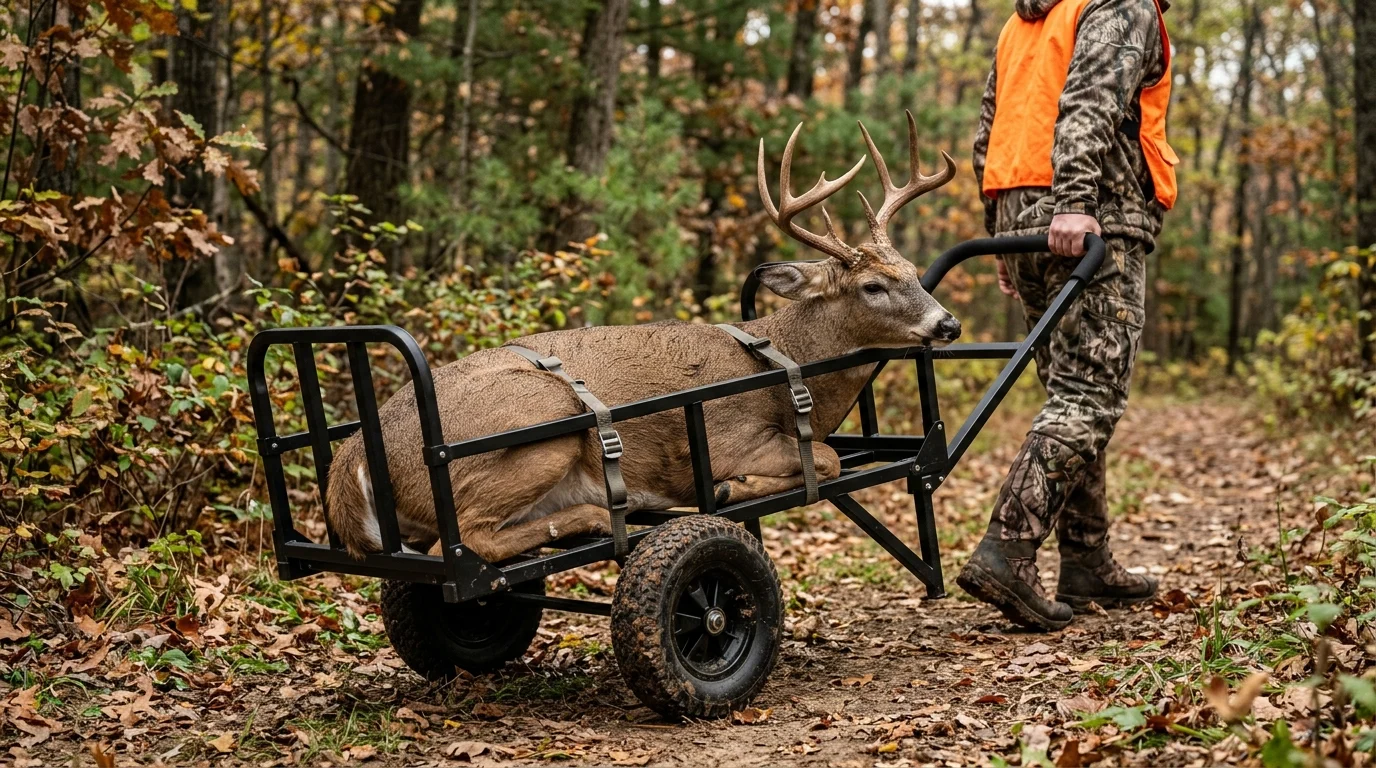
A long deer recovery can turn a successful hunt into the hardest part of the day, especially when a mature buck is down a mile from the truck. The right folding game carrier can reduce strain, protect meat from dirt, and make solo extraction far safer, but it is not as simple as buying the biggest cart available. Terrain, local public-land rules, carrying distance, wheel design, frame strength, and packability all matter. This guide explains when a carrier is worth using, how it compares with ropes, sleds, and frame packs, and what features help most when the drag is long and the trail is unforgiving.
Why a Folding Deer Game Carrier Matters
I’ve been there—staring at a downed buck a mile and a half from the truck, realizing the real work is just starting. Dragging a mature whitetail by the antlers is a brutal test of endurance that can quickly become dangerous. In fact, a widely cited study by researchers at Beaumont Hospital found that the strenuous activity of dragging a deer can elevate a hunter’s heart rate up to 118% of their maximum recommended limit, significantly increasing the risk of a cardiac event.
That’s exactly why investing in a reliable hunting Deer Folding Game Carrier isn’t just a luxury; it’s a critical piece of gear for your health, safety, and overall hunting efficiency.
When a game carrier is worth using
Honestly, if you are hunting solo, a game cart is worth its weight in gold. I make it a rule to deploy my carrier anytime the drag exceeds 400 yards. Dragging a deer over long distances not only exhausts you, but it also ruins the hide and can introduce dirt and debris into the meat cavity if the animal is field-dressed.
A folding model specifically matters because of logistics. Most of us don’t have unlimited cargo space. A folding carrier collapses flat, allowing you to easily slide it under a tonneau cover, strap it to an ATV, or even stash it in the brush near your tree stand without drawing attention.
Here are the primary scenarios where I consider a carrier mandatory:
- Solo public land hunts: When you don’t have hunting buddies to grab an antler and share the load.
- Deep backcountry setups: When you need to haul out a heavy climber stand or blind alongside your harvest.
- Warm weather hunts: When you need to get the deer back to the cooler rapidly to prevent meat spoilage.
How terrain, deer size, and distance affect your choice
You can’t just buy the cheapest cart on the shelf and expect it to survive a heavy load in the timber. The specific environment you hunt should dictate the frame strength, wheel size, and balance of the cart you choose.
If I shoot a 200-pound Midwestern buck, a flimsy cart with thin plastic wheels will literally fold under the pressure the moment it hits a rut. Conversely, a massive, heavy-duty steel cart might be overkill if you are just pulling a doe across a flat, cut cornfield.
To help you match your gear to your hunt, I use this basic decision matrix:
| Hunt Scenario | Terrain & Distance | Ideal Carrier Specifications |
|---|---|---|
| Agricultural / Flat | Smooth fields, short distances (< 1/2 mile) | Lightweight aluminum frame, standard 14-inch spoked wheels. |
| Deep Timber / Rugged | Logs, rocks, muddy trails (1+ miles) | Heavy-duty steel frame, 18 to 20-inch solid rubber, puncture-proof tires. |
| Trophy / Heavy Game | Any terrain, large mature bucks or elk quarters | Dual-axle design or centered axle to reduce tongue weight on your arms. |
Ultimately, the rougher the terrain and the heavier the deer, the larger your wheels need to be. Larger wheels roll over downed branches and rocks much easier than small wheels, which tend to dig into the mud and act like anchors. Pay close attention to these factors, and your long drags will feel like a walk in the park.
When is a game carrier worth using?
Honestly, if you are hunting solo, a game cart is worth its weight in gold. I make it a rule to deploy my carrier anytime the drag exceeds 400 yards. Dragging a deer over long distances not only exhausts you, but it also ruins the hide and can introduce dirt and debris into the meat cavity if the animal is field-dressed.
A folding model specifically matters because of logistics. Most of us don’t have unlimited cargo space. A folding carrier collapses flat, allowing you to easily slide it under a tonneau cover, strap it to an ATV, or even stash it in the brush near your tree stand without drawing attention.
Here are the primary scenarios where I consider a carrier mandatory:
- Solo public land hunts: When you don’t have hunting buddies to grab an antler and share the load.
- Deep backcountry setups: When you need to haul out a heavy climber stand or blind alongside your harvest.
- Warm weather hunts: When you need to get the deer back to the cooler rapidly to prevent meat spoilage.
How do terrain, deer size, and distance affect your choice?
You can’t just buy the cheapest cart on the shelf and expect it to survive a heavy load in the timber. The specific environment you hunt should dictate the frame strength, wheel size, and balance of the cart you choose.
If I shoot a 200-pound Midwestern buck, a flimsy cart with thin plastic wheels will literally fold under the pressure the moment it hits a rut. Conversely, a massive, heavy-duty steel cart might be overkill if you are just pulling a doe across a flat, cut cornfield.
To help you match your gear to your hunt, I use this basic decision matrix:
| Hunt Scenario | Terrain & Distance | Ideal Carrier Specifications |
|---|---|---|
| Agricultural / Flat | Smooth fields, short distances (< 1/2 mile) | Lightweight aluminum frame, standard 14-inch spoked wheels. |
| Deep Timber / Rugged | Logs, rocks, muddy trails (1+ miles) | Heavy-duty steel frame, 18 to 20-inch solid rubber, puncture-proof tires. |
| Trophy / Heavy Game | Any terrain, large mature bucks or elk quarters | Dual-axle design or centered axle to reduce tongue weight on your arms. |
Ultimately, the rougher the terrain and the heavier the deer, the larger your wheels need to be. Larger wheels roll over downed branches and rocks much easier than small wheels, which tend to dig into the mud and act like anchors. Pay close attention to these factors, and your long drags will feel like a walk in the park.
Key Features of a Good Folding Game Carrier
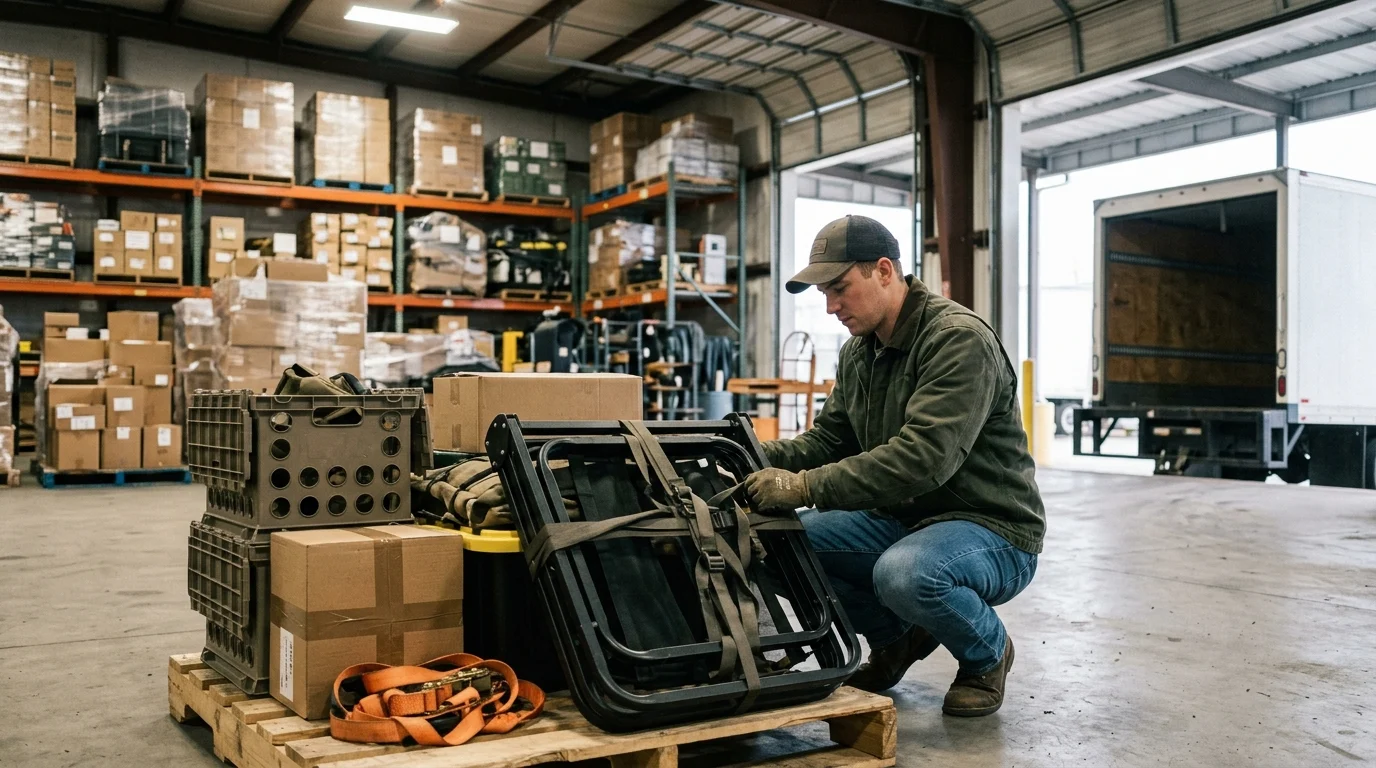
When you are two miles deep in a swamp with a fading flashlight battery and a heavy load, the last thing you want to hear is the crack of a snapping axle or the bending of a cheap aluminum frame. I’ve seen bargain-bin carts fail spectacularly in the field, leaving hunters stranded with a broken cart and a whole deer to deal with. To avoid that nightmare, you need to know exactly what engineering features separate a reliable, lifetime piece of gear from a single-season throwaway.
A top-tier folding game carrier is an exercise in balancing strength and portability. It needs to be robust enough to handle shock loads when dropping off a log, yet light and compact enough to fit in the trunk of a sedan or strap to an ATV rack. Let’s break down the frame design and components of a heavy-duty carrier.
Frame materials, load ratings, and axle strength
The skeleton of your carrier dictates its lifespan. Most carts on the market are constructed from either square steel tubing or aircraft-grade aluminum, each offering distinct advantages:
- Steel Frames: Steel is the traditional workhorse. A solid, powder-coated steel frame will typically weigh between 35 and 45 pounds. Manufacturers often advertise static load ratings of 500 to 600 pounds for these models, though actual capacities vary by brand. The downside to steel is the weight you have to carry into the woods and its susceptibility to rust if the coating gets scratched.
- Aluminum Frames: Aluminum carriers are a solo hunter’s dream for portability. A high-quality aluminum cart usually weighs between 20 and 25 pounds, cutting your pack-in weight in half. The trade-off is often a lower load rating—typically around 300 to 350 pounds, depending on the manufacturer. For most whitetail hunters, 300 pounds is plenty, but you must check the welds. Look for continuous TIG welds on aluminum frames, not just tack welds.
- Axle Strength: The absolute most critical failure point on any game cart is the axle. In most cases, you should avoid buying a cart with a hollow axle or an axle less than 5/8-inch in diameter. A common benchmark for a rugged cart is a 3/4-inch solid steel axle, though specifications differ across brands. When a heavy deer on the cart drops off an 8-inch log, the dynamic force on the axle generates massive shock loads. A hollow axle can bow under these conditions, often causing the wheels to toe inward and rub against the frame until they lock up completely.
Wheel design, handle comfort, and packed size
Wheels make or break the hauling experience. Rule number one of game carts: avoid standard pneumatic (air-filled) tires unless they are run-flat or foam-filled alternatives. The woods are full of honey locust thorns, sharp rocks, and jagged branches. A flat tire on a game cart is a hunt-ruining event. Always opt for solid polyurethane, micro-cellular polyurethane, or foam-filled tires. They provide the bounce and shock absorption of air without the risk of flats.
Wheel diameter is also crucial for ground clearance and rolling resistance. Small 14-inch wheels will get hung up on every root and rut. You generally want a minimum wheel diameter of 16 inches, but 18 to 20 inches is ideal for rolling over deadfall and navigating deep mud. The spokes should be heavy-duty steel, not plastic.
Handle comfort is often overlooked until you are an hour into a drag. You want a handle that allows you to walk fully upright with your arms slightly bent. If the handle forces you to lean forward, you will fatigue rapidly. As for packed size, many good folding carriers collapse down to roughly 40 inches long by 20 inches wide by 5 inches thick as a general benchmark. This ensures the cart can slide easily into the back of an SUV, under a tonneau cover, or lay flat on an ATV rack.
Folding mechanism and field durability
A folding carrier is only as strong as its hinges and locking mechanisms. The joints where the cart folds in half are inherent weak points. High-end carts utilize heavy-duty steel gussets at the folding joints to reinforce the frame. The folding mechanism usually relies on locking pins to keep the cart rigid during use.
Pay close attention to these pins. They should ideally be at least 1/4-inch thick, made of hardened steel, and feature wire loop retainers so they don’t get lost in the leaves. Spring-loaded detent pins are faster to deploy, but D-wire lock pins are generally more fail-proof in freezing, icy conditions. Avoid any cart that uses plastic knobs or threaded bolts that require tools for field assembly; your fingers will be cold, and you will inevitably drop a nut in the snow.
| Feature | Powder-Coated Steel Frame | Aircraft-Grade Aluminum Frame |
|---|---|---|
| Average Weight | 35 – 45 lbs | 20 – 25 lbs |
| Typical Load Capacity | 500 – 600 lbs | 300 – 350 lbs |
| Durability / Flex | High rigidity, handles shock well | Slight flex under max load |
| Corrosion Resistance | Moderate (rusts if scratched) | Excellent (will not rust) |
| Best Suited For | Big woods, massive game, ATVs | Solo hunters, long pack-ins |
How to Compare Deer Game Carrier Designs
Walking down the aisle of a sporting goods store or browsing online, the sheer variety of game transport options can be overwhelming. While the previous section covered materials and components, choosing the right overall structural design requires an honest assessment of how you hunt, where you hunt, and whether you typically have a hunting partner.
To make an informed decision, you need to understand the physics of these different geometries. How a carrier distributes weight between the wheels and your hands will dictate how exhausted you feel at the end of the trail.
Two-wheel carts vs. compact folding carriers
The standard two-wheel V-shaped cart is the classic design, and for good reason. By placing the axle directly in the center of the load, a well-balanced two-wheel cart carries roughly 80 to 90% of the animal’s weight on the wheels, leaving only a fraction for your arms to lift and pull. This design is unbeatable for relatively clear logging roads, open fields, and moderate woodland trails.
However, two-wheel carts have a distinct disadvantage in extremely thick brush or on steep side-hills. Because they have a wide track (often 24 to 28 inches wide), one wheel might ride up a stump while the other drops into a rut, threatening to tip the whole rig over. This is where ultra-compact folding carriers or single-wheel inline carts shine. Single-wheel designs track directly behind you, making them perfect for narrow game trails, though they require more lateral balance from the hunter.
If you hunt deep backcountry where even a compact wheeled cart is too bulky, using a heavy-duty packout system—like a folding game bag or a frame pack—is often a deliberate first choice rather than a fallback. This method allows you to carry the meat directly on your back over terrain where wheels simply cannot go.
Best designs for solo hunters and rough terrain
If you are a solo hunter, your primary concern is ease of loading. Trying to deadlift a limp 180-pound buck onto a cart that sits two feet off the ground is a recipe for a hernia. The best designs for solo hunters feature a low center of gravity or a slanted axle design that allows you to tilt the cart flat onto the ground, roll the deer onto the mesh, and use leverage to tip the cart back up onto its wheels.
For rough, uneven terrain, look for carts that feature independent axle suspension or oversized wheels. Some modern carts feature a bent axle design, which lowers the cargo bed below the center line of the wheels. This dramatically lowers the center of gravity, making the cart vastly more stable on side-hills and preventing the dreaded “cart roll-over” that dumps your hard-earned harvest into the mud.
Another factor for rough terrain is the handle configuration. A single straight handle limits your grip options. Carts with dual-handle setups or adjustable angled handles allow you to change your grip, push instead of pull, or even step inside the handles to use your body weight and a waist belt to drag the cart forward, freeing up your hands.
Comparison factors: capacity, weight, wheels, and storage
When comparing models side-by-side, always look for a balanced ratio where the cart’s physical weight is a reasonable fraction of its maximum load capacity. For example, a cart weighing 30 pounds should ideally be rated to carry at least 250 to 300 pounds. If a cart weighs 45 pounds but is only rated for 200 pounds, it may be poorly engineered with unnecessarily heavy, low-grade materials.
Storage footprint is another massive comparison factor. A cart that doesn’t fold flat is virtually useless to a hunter driving a standard pickup with a bed full of coolers and gear, or an SUV. You want a design where the wheels can be quickly removed via cotter pins, allowing the frame to fold in half like a clamshell, minimizing the space it takes up during transit.
| Design Type | Best Terrain | Pros | Cons |
|---|---|---|---|
| Standard 2-Wheel V-Cart | Logging roads, open fields | Excellent weight distribution, high capacity | Wide footprint, prone to tipping on side-hills |
| Single-Wheel Inline Cart | Narrow game trails, thick brush | Tracks perfectly behind hunter, highly maneuverable | Requires physical effort to balance laterally |
| Low-Profile / Drop-Axle | Uneven ground, steep hills | Very low center of gravity, easy solo loading | Lower ground clearance over large logs |
| Compact Sled / Game Bag | Snow, swamps, dense deadfall | Zero mechanical failure points, glides over mud | High friction on dry ground, physically demanding |
How to Match a Carrier to Your Hunt
Buying the right cart is only half the battle; knowing how to deploy it effectively in the field is what actually saves your back. I’ve watched hunters struggle with high-end carriers simply because they didn’t match their hauling strategy to the environment or they loaded the cart completely wrong.
A successful extraction requires a bit of forethought. You need to map your route, understand the physics of your load, and anticipate the obstacles between you and your tailgate. Here is how to match your carrier technique to your specific hunt.
Estimate drag distance and dressed deer weight
Before you even step foot in the woods, you should have a rough estimate of your drag distance and the potential weight you’ll be hauling. A common rule of thumb for whitetail deer is that the field-dressed weight will roughly be around 78% of the live weight. However, keep in mind that dress-out percentages vary widely by the deer’s sex, age, body condition, and regional subspecies, so it is best to estimate conservatively. If you drop a heavy 200-pound live buck, you are likely looking at roughly 155 pounds of dead weight to haul out.
If your drag distance is under half a mile, you can afford to take a heavier, steel cart and power through it. But if you are trekking 1.5 to 2 miles back into public land, every pound of the cart itself becomes a burden on the hike in. For these long-range missions, strapping a lightweight, 20-pound aluminum folding carrier to your pack frame is often the better choice.
Always scout your extraction route on your digital mapping app before you start hauling. The path you took to sneak into your stand quietly is rarely the best path for rolling a wide cart out. Look for topographic saddles, dry creek beds, or old logging paths that offer the path of least resistance, even if it adds a few hundred yards to the total distance.
Balance, lash, and secure the load properly
The biggest mistake hunters make is throwing the deer onto the cart haphazardly. If the bulk of the weight is too far forward, you will be lifting 50 pounds with your arms the entire hike. If the weight is too far back, the cart will act like a seesaw, constantly trying to pop the handle out of your hands.
The goal is absolute neutrality. Position the deer so that the heaviest part—the chest cavity and shoulders—is centered directly over the axle. The head and neck should be tucked securely inside the frame so antlers don’t catch on passing brush. Once you find that balance point where the cart practically hovers in your hands, lock it down.
You must lash the load securely. Do not rely on bungee cords; they stretch and allow the load to shift on side-hills, which will immediately tip the cart. Use at least three heavy-duty ratchet straps or cam-buckle straps.
Final Buying Checklist
I’ve hauled enough field-dressed whitetails out of steep ravines to know that the right hunting Deer Folding Game Carrier is worth its weight in gold. But grabbing the first cheap option you see online usually leads to a broken axle and a miserable drag back to the truck. Before you finalize your setup, let’s run through the essential checklist I use to evaluate any game cart.
Durability vs. portability trade-offs
When you’re three miles deep into public land, every ounce you carry matters. But when you’re dragging a mature buck out, frame strength is everything. According to harvest data from the National Deer Association, mature field-dressed bucks in the Midwest and Northern states regularly exceed 175 to 200 pounds.
You have to balance the cart’s empty weight with its structural integrity. Aluminum frames keep the carrier highly portable (often weighing under 20 pounds) and completely resist rust, but they can warp under heavy, shifting loads. Steel frames, on the other hand, are incredibly durable and won’t bend easily, but they add significant weight to your hike in. I always recommend evaluating your typical hunting grounds: if you hunt flat, long-distance terrain, lean toward aluminum. If you’re navigating rocky, rutted hillsides, take the weight penalty of a steel frame.
Must-have features for reliable field use
A hunting Deer Folding Game Carrier is only as good as its weakest component. Over the years, I’ve learned to look for a few non-negotiable specs before pulling the trigger on a purchase:
- Puncture-proof tires: Never buy air-filled (pneumatic) tires if you hunt in areas with locust thorns, briars, or sharp shale. Solid rubber or high-density polyurethane tires are mandatory.
- Secure locking pins: The folding joints must use heavy-duty steel wire-lock pins. Friction locks or cheap plastic clips will collapse the second you hit a stump on a downhill slope.
- Wide wheelbase: Look for an axle width of at least 18 to 20 inches to prevent the cart from tipping over on uneven trails.
| Component | Standard Budget Option | Professional Field-Grade Option | Impact on Dragging |
|---|---|---|---|
| Tires | Pneumatic (Air-filled) | Solid Polyurethane/Rubber | Eliminates flat tires miles from the truck |
| Axle | 1/2-inch hollow tube | 3/4-inch solid steel | Prevents axle bowing under 200+ lb loads |
| Joint Locks | Plastic tension clips | Steel wire-lock pins | Keeps the frame rigid over rough terrain |
Common mistakes to avoid before buying
The most frequent mistake I see hunters make is ignoring the carrier’s folded dimensions. A cart might boast an impressive 500-pound capacity, but if it doesn’t fold down small enough to fit in your SUV or the back of your ATV alongside your cooler and weapon, it’s going to be a logistical nightmare.
Another trap is underestimating the center of gravity. Buying a cart with an excessively high deck clearance might seem great for rolling over fallen logs, but it makes the load top-heavy and highly prone to rolling over on side-hills. Finally, don’t forget to check the handle ergonomics. A straight, unpadded metal bar will destroy your hands over a two-mile drag. Look for angled handles with high-density foam or rubberized grips to keep your wrists in a natural, comfortable pulling position.
Key Takeaways
- Plan to use a game carrier when the recovery distance approaches 500 yards or more, because dragging a deer that far can quickly become exhausting.
- Check public land rules before your hunt, since some areas prohibit wheeled carts, restrict trail access, or ban unattended equipment.
- A folding game carrier reduces friction by moving the deer’s weight onto wheels, making a 150-pound animal far easier to transport.
- Solo hunters should treat a reliable carrier as essential gear for deep-woods setups where no partner is available to share the workload.
- If wheels are illegal or impractical, quarter the deer and pack it out with a heavy-duty frame instead of forcing a risky drag.
Frequently Asked Questions
When is a folding game carrier worth bringing?
A useful rule of thumb is any deer recovery beyond about 500 yards, especially if you hunt solo, face uneven ground, or need to preserve energy for a safe trip home.
Are wheeled game carriers legal on all public land?
No. Some public lands restrict wheeled carts, trail width, seasonal equipment use, or off-trail travel. Always check local regulations before relying on a carrier.
Why choose a folding game carrier instead of a drag rope?
A folding carrier reduces ground friction, keeps meat cleaner, and turns a heavy drag into a rolling load, which can save significant effort over long distances.
What should solo deer hunters prioritize in a carrier?
Solo hunters should prioritize balance, strong wheels, durable frame construction, secure tie-down points, and a compact folding design that is manageable without help.
What if carts are banned or the terrain is too rugged?
If wheels are not allowed or practical, quarter the deer and use a heavy-duty frame pack designed to carry meat safely over rough terrain.
Post time: Jul-31-2026