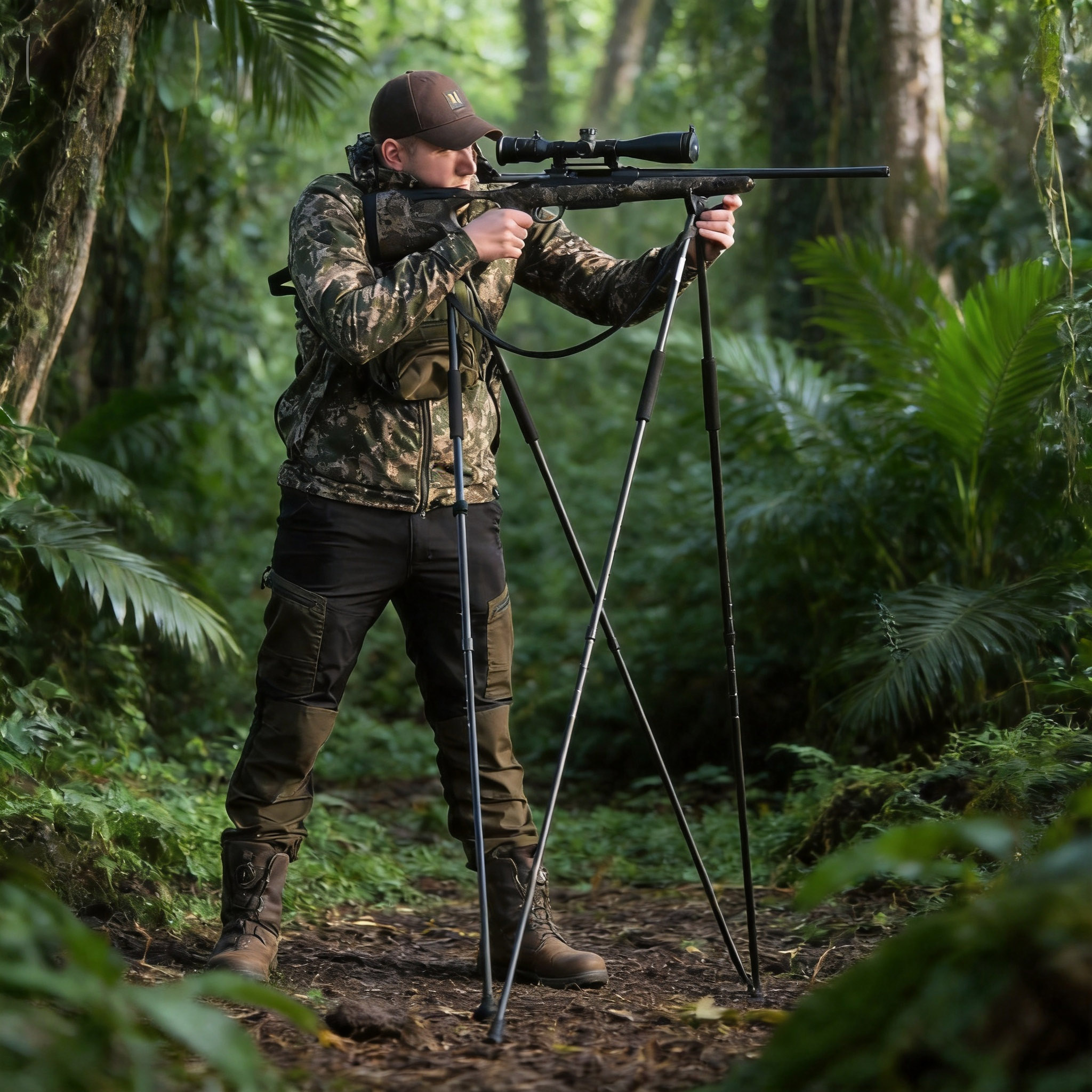
 Distributor buying patterns are revealing a clear shift in the hunting accessories market: stability, portability, and fast deployment are now driving purchasing decisions. As consumer searches rise and wholesale MOQs move from cautious trials to 1,000–2,500-unit commitments, foldable aluminum four-legged shooting supports are becoming a strategic stock item rather than a seasonal add-on. These products promise a practical middle ground between lightweight field gear and bench-rest precision, especially for hunters who need dependable support on uneven terrain. This article examines the demand signals, product specifications, and stocking logic behind the surge—and why distributors are moving early to secure inventory before peak hunting season.
Market Demand for Foldable Aluminum Four-Legged Hunting Supports
Wholesale trends in the outdoor gear sector indicate that one specific item is dominating distributor purchasing sheets: the four-legged shooting support. Walking the aisles of major trade shows or analyzing the inventory forecasting software of top-tier hunting distributors reveals a massive shift away from traditional bipods and heavy, cumbersome bench rests. Instead, buyers are pouring capital into highly portable, ultra-stable solutions.
This is not just a fleeting trend. Hunters and outdoor enthusiasts are demanding gear that bridges the gap between lightweight mobility and rock-solid precision. Distributors are stocking up because these products solve a very real problem in the field, and more importantly, they offer fantastic retail margins. The specific market dynamics driving this surge highlight exactly what makes these supports such a hot commodity.
Key demand signals distributors are watching
Distributors rely on hard, actionable data rather than guesswork. Over recent fiscal quarters, wholesale inquiries for advanced shooting supports have jumped significantly. MOQ (Minimum Order Quantity) requests from regional wholesalers have shifted from cautious trial runs to aggressive bulk orders of 1,000 to 2,500 units.
Another massive demand signal is retail search volume. Big-box outdoor retailers are reporting strong year-over-year increases in consumer searches for “quad shooting sticks” and “standing shooting rests.” When end-user demand spikes this consistently, distributors know they need to secure inventory before the late-summer manufacturing rush hits. They are locking in factory capacity now to ensure they do not stock out during the highly lucrative autumn hunting seasons.
What defines a foldable aluminum four-legged hunting support
It is important to clarify product category terminology: while “shooting sticks” commonly refers to simple V-yoke walking sticks or seat sticks in many markets, the current demand centers on foldable four-legged bench rests. This specialized piece of gear is designed to offer maximum stability in unpredictable terrain. Unlike a standard bipod that only stabilizes the front of a rifle, a four-legged system supports both the forend and the buttstock, effectively creating a portable shooting bench.
Generally manufactured from aircraft-grade aluminum, these supports are engineered to be incredibly tough yet shockingly light, usually weighing in at a highly portable 2.2 to 2.8 pounds. They fold down into a compact profile, making them a breeze to strap to a backpack and carry deep into the backcountry. For an example of what distributors are eager to source, consider designs like these hunting shooting 4 legged sticks. The combination of rapid deployment and dual-point stability is exactly what defines this product category, even if they are not universally superior for every scenario—such as fast-paced mountain hunts or navigating dense brush, where their added bulk can slow down target acquisition compared to simpler bipods.
Product Specs Driving Distributor Interest

Distributors know that to move volume, the product has to perform flawlessly in harsh conditions. That means the materials, the engineering, and the subtle quality-of-life features have to be dialed in perfectly. The specific product specifications driving distributor interest are what make these supports fly off the shelves.
Aluminum construction and four-legged stability
Aluminum is the undisputed king of materials in this category, but not all aluminum is created equal. Most high-quality four-legged supports utilize either 6061 or 7075 aluminum alloys. Distributors should look closely at these numbers. 6061 aluminum offers a solid yield strength of about 40,000 psi, which is great for standard use. However, premium models often upgrade to 7075 aluminum, pushing that yield strength past 73,000 psi.
This incredible strength-to-weight ratio is what allows the four-legged design to function without buckling under pressure. The stability comes from the wide footprint and the independent adjustability of each leg. When a hunter is set up on a steep, rocky incline, they need to be able to adjust each of the four legs to different heights to achieve a perfectly level shooting platform. The rigidity of the aluminum ensures that once those legs are locked in, there is zero wobble.
Four-legged supports vs. shooting sticks
Why are buyers shifting toward four legs instead of sticking with traditional one, two, or three-legged options? It comes down to the mechanics of precision shooting. A monopod or bipod provides a decent resting point, but the shooter still has to manage the rearward weight and movement of the weapon. A four-legged support (often called a quad-pod) locks the weapon in place at two distinct contact points.
A direct comparison of support types highlights the trade-offs. The illustrative benchmarks below demonstrate hypothetical stability scores and utility in the field.
| Support Type | Illustrative Stability Score (1-10) | Est. Setup Time (secs) | Points of Contact | Ideal Use Case |
|---|---|---|---|---|
| Monopod | 3 | 2-3 | 1 | Quick shots, heavy brush |
| Bipod | 6 | 5-7 | 1 | Prone or sitting, level ground |
| Tripod | 8 | 10-15 | 1 (sometimes clamped) | Standing shots, glassing |
| Four-Legged | 10 | 12-18 | 2 (Front & Rear) | Long-range precision, blind hunting |
While it takes a few seconds longer to deploy, the dual-point stability is unmatched. This is exactly why premium shooting 4 legged sticks are becoming the go-to choice for serious marksmen who cannot afford to miss a critical shot due to weapon sway.
Durability, weight capacity, noise control, and grip
Beyond the core frame, distributors are obsessed with the finer details: durability, weight capacity, noise control, and grip. A quality unit isn’t just about surviving a drop from a truck tailgate; it’s about holding substantial weight safely. Top-tier four-legged supports boast a static weight capacity of at least 50 to 65 lbs, ensuring they can handle heavy precision rifles without the locking mechanisms slipping.
Noise control is another massive factor. In the woods, a metallic clank can ruin a hunt instantly. Ideal specs include 3mm to 5mm thick TPR (Thermoplastic Rubber) coatings on all yokes, joints, and locking levers. This rubberization not only dampens sound significantly compared to bare metal, but it also provides a non-slip grip when the hunter is wearing thick winter gloves. These are the micro-specs that trigger positive retail reviews.
Sourcing, Pricing, and Quality Control
Buying these units at scale means navigating a complex minefield of sourcing, pricing negotiations, and rigorous quality control. Distributors must remember that the absolute cheapest factory quote is rarely the best quote. Compromising on quality to save a few pennies will result in return rates that obliterate profit margins.
To successfully stock up on four-legged supports, a distributor has to understand the underlying economics of manufacturing them. From raw material costs to the final factory inspection, every step of the sourcing journey requires careful oversight and a solid understanding of international trade metrics.
Key cost drivers for bulk orders
The cost drivers for bulk orders are fascinating to break down. The primary variable is the cost of raw aluminum, which fluctuates based on global spot market prices. However, the real cost isn’t just the raw metal; it’s the CNC machining, the anodizing process, and the manual assembly of the articulating joints. Additionally, buyers must factor in import tariffs or anti-dumping duties on manufactured aluminum goods, which can significantly alter the final landed cost.
Economy of scale plays a massive role here. Committing to a larger production run can often drive the landed unit cost down by 15% to 18%. That difference per unit translates to a massive margin increase when the product hits retail shelves at a premium MSRP.
Supplier checks before placing large orders
Before signing off on a massive purchase order, strict supplier checks are mandatory. Wiring thousands of dollars overseas based on a glossy catalog is a major risk. Distributors should look for factories that hold active ISO 9001 certifications, guaranteeing they have standardized quality management systems in place.
It is also crucial to assess intellectual-property risks; sourcing patent-claimed designs from offshore factories without proper vetting can lead to legal complications at the port of entry. Furthermore, production lead times and historical on-time delivery rates must be heavily scrutinized. A reliable supplier will typically quote a production lead time of 45 to 60 days. Unrealistic promises usually mean the work is being outsourced to unvetted sub-contractors, leading to faulty locking mechanisms and mismatched anodized colors.
Sample inspection steps for distributors
Sample inspection is where the rubber meets the road. Before full production begins, distributors must demand pre-production samples and test them rigorously. Industry best practices recommend a minimum of three specific tests to ensure the product will survive the retail market.
First, a dynamic load test: suspending a heavy weight from the central yoke of the deployed stick for 48 hours ensures the leg locks do not slip. Second, a salt spray test: the aluminum parts should endure 72 hours in a salt fog chamber without showing signs of corrosion or blistering on the finish. Finally, a cycle test on the hinges: opening and closing the four legs repeatedly ensures the tension screws don’t back out. If the sample passes these checks, the product is ready for bulk production.
Logistics, Compliance, and Retail Readiness
Once the manufacturing is sorted and the quality is verified, the logistics, compliance, and retail readiness phases begin. Brilliantly engineered products can fail miserably simply because they cost too much to ship or do not fit cleanly on a standard retail pegboard.
Distributors have to think about the physical footprint of the product just as much as its functionality. Moving aluminum sticks across the ocean and into regional warehouses requires spatial efficiency and precise supply chain timing.
Folded length, carton design, and freight planning
Folded length is arguably the holy grail of freight planning in this product category. If a four-legged stick folds down to 24 inches instead of 36 inches, the shipping economics change completely. A shorter folded length means smaller master cartons, allowing significantly more units onto a standard shipping pallet. Furthermore, actual carrier dimensional-weight rules (chargeable weight versus simple carton math) mean that bulky packaging can incur massive surcharges, making compact folding mechanisms even more critical.
The following hypothetical table illustrates how a few inches of folded length impacts the bottom line when importing a standard 40-foot shipping container.
| Folded Length | Units per Master Carton | Cartons per Pallet | Total Units per Pallet | Hypothetical Freight Cost per Unit |
|---|---|---|---|---|
| 36 inches | 10 | 12 | 120 | $4.50 |
| 30 inches | 15 | 16 | 240 | $2.85 |
| 24 inches | 20 | 20 | 400 | $1.90 |
By optimizing the design to fold down to 24 inches, a distributor can slash their inbound freight costs dramatically. This logistical efficiency is a primary reason why modern, highly collapsible designs are dominating distributor catalogs.
Seasonal demand and sales channel planning
The hunting and outdoor industry is brutally seasonal. To have these supports on the shelf for the September archery and early rifle seasons, the supply chain cycle needs to be planned months in advance. Distributors cannot afford to have their capital tied up in inventory that arrives two weeks after the hunting season opens.
Typically, this requires a 90 to 120-day window from the issuance of the purchase order to the product arriving at the retail distribution center. Successful distributors finalize their factory orders in March and April, factoring in time for production, ocean freight, customs clearance, and domestic trucking. Timing this seasonal wave perfectly separates profitable distributors from those stuck paying warehouse storage fees all winter.
Labeling, warranty, and safety requirements
Retailers demand strict compliance before they will put a product on their shelves. Distributors must ensure that the packaging includes clear, legally compliant labeling. This includes country of origin markings, UPC barcodes that scan flawlessly, and necessary safety warnings, such as pinch-point hazards on the folding mechanisms.
Warranty support is equally critical. Major retailers expect the distributor to handle warranty claims, requiring a defect allowance built into financial models. The industry gold standard is maintaining a defect rate of under 1.5%. If the factory produces a reliable product that stays under this threshold, the distributor can comfortably offer a limited warranty, which massively boosts consumer confidence and drives retail sales.
How Distributors Should Decide Whether to Stock Up
After analyzing market demand, scrutinizing aluminum specs, calculating freight numbers, and verifying factory compliance, the final question remains: should a distributor stock up heavily on four-legged shooting supports?
The data points to a resounding yes, provided the financial strategy is mapped out correctly. The upfront capital risk must be balanced against the projected inventory turnover velocity. Smart distributors rely on structured matrices to make this final go/no-go decision.
Decision matrix for margin, demand, and risk
A strict financial decision matrix is recommended. First, target a gross margin of at least 45% to 55% at the wholesale level. If the landed cost of the unit is optimized, the distributor needs to be able to wholesale it to retailers at a price that allows the retailer to hit a profitable MSRP.
Risk mitigation is the second part of the matrix. Sourcing a premium, patent-protected design rather than a generic item allows for a higher MSRP. Premium positioning with products like aluminum hunting shooting 4 legged sticks insulates margins from minor fluctuations in ocean freight rates or sudden spikes in raw aluminum costs. Demand is currently strong for these premium designs, which significantly lowers the risk of dead stock.
Final takeaway for stocking strategy
The market is undergoing a permanent shift toward highly stable, multi-point shooting supports. The four-legged design is a measurable, functional upgrade that modern hunters are actively seeking out and are willing to pay a premium for.
Distributors who recognize this shift and aggressively secure high-quality, compact-folding inventory are positioning themselves to capture massive market share. By focusing on stringent quality control, optimizing folded lengths for freight efficiency, and timing their seasonal orders perfectly, these distributors are building a highly profitable, cornerstone product category for years to come.
Key Takeaways
- Distributors should monitor search demand for terms like “quad shooting sticks” and “standing shooting rests” because rising retail interest is driving larger wholesale commitments.
- Bulk buyers are increasingly moving from trial orders to MOQ requests of 1,000 to 2,500 units, indicating that this category has shifted from niche product to priority inventory.
- Foldable aluminum four-legged supports appeal to hunters because they combine dual-point rifle support with portable weights of about 2.2 to 2.8 pounds.
- Retailers should position these products as portable bench-style supports rather than ordinary shooting sticks to communicate their stability advantage clearly.
- Buyers should secure factory capacity before the late-summer rush to avoid missed sales during the autumn hunting season.
- Merchandising should acknowledge use-case limits, since four-legged systems are highly stable but may be less convenient than bipods in dense brush or fast-moving hunts.
Frequently Asked Questions
Why are distributors increasing orders for four-legged shooting supports?
Distributors are responding to rising consumer demand for portable, stable hunting rests, stronger retail search volume, and attractive margins ahead of peak autumn hunting seasons.
How are four-legged shooting sticks different from bipods?
A bipod supports mainly the rifle forend, while a four-legged system supports both the forend and buttstock, creating a more bench-like shooting platform in the field.
What order volumes are wholesalers requesting?
Many regional wholesalers have moved from small trial orders to bulk MOQ requests of roughly 1,000 to 2,500 units, signaling stronger market confidence.
What weight range makes these supports attractive to hunters?
Many foldable aluminum four-legged supports weigh about 2.2 to 2.8 pounds, offering a balance of portability, strength, and field stability.
Why is aluminum commonly used in these hunting supports?
Aircraft-grade aluminum provides a strong but lightweight structure, helping hunters carry the support into the field without sacrificing durability.
Post time: Jul-24-2026