
Why Compact Hunting Sticks Matter for Buyers
For those paying attention to the outdoor sporting goods market lately, it is clear that the days of hunters lugging around heavy, cumbersome gear are fading. For sourcing professionals walking factory floors and reviewing spec sheets, mobility has become a primary requirement. Buyers aren’t just looking for a stick to rest a rifle on; they want an engineered solution that packs down small, deploys in seconds, and doesn’t add unnecessary bulk to their pack.
That’s exactly why adding a highly engineered compact hunting stick—such as the illustrative supplier example linked here—to a retail or distribution portfolio is a strategic play right now. There is a massive shift toward specialized, multi-functional gear. When a portfolio offers a product that acts as a height-adjustable, 4-legged shooting stick, it isn’t just selling an accessory—it is providing a highly stable, versatile tool for the field. Let’s break down exactly why this category is driving revenue and how to capitalize on it.
Commercial value and market demand
From a commercial standpoint, the value proposition of a compact shooting stick is undeniable. The global hunting equipment market has been steadily growing, but the niche for ultra-lightweight, high-stability support systems is outpacing the broader category. While specific growth rates vary, hypothetical industry models often project a compound annual growth rate (CAGR) around 6.5% for lightweight support systems. Retailers value these products because they offer excellent margin profiles. Based on illustrative sourcing models, a well-sourced, feature-rich stick can yield estimated retail gross margins anywhere from 40% to 60%, depending on the materials and the brand positioning.
Market demand is being driven by a consumer base that is increasingly educated about gear. Today’s hunters watch hours of video content and read extensive forum reviews before making a purchase. They know that a standard, cheap monopod won’t cut it for a 300-yard shot in crosswinds. They are willing to spend upwards of $100 to $250 at retail for a premium, compact system that provides reliable stability. Portfolios that only include entry-level, heavy steel or basic fiberglass sticks are leaving money on the table.
Key buyer segments and use cases
To source effectively, it is essential to know exactly who is buying the product. The primary segment driving the demand for compact, 4-legged designs is the spot-and-stalk hunter. These are the individuals hiking 5 to 10 miles a day in rugged terrain. For them, every ounce matters. Informal industry surveys and anecdotal field observations suggest a significant majority—often estimated around 70% in hypothetical models—of western big-game hunters prioritize support gear that weighs under 2.5 lbs and can strap easily to the outside of a daypack.
Another massive buyer segment includes predator hunters and those shooting from ground blinds. These users need a system that can transition smoothly from a sitting height of around 35 inches to a standing height of over 60 inches without requiring them to take their eyes off the target. By understanding these distinct use cases, buyers can dictate better terms to suppliers—ensuring the models sourced have the exact leg angles, grip materials, and deployment mechanisms that these specific buyers demand.
Define Product Requirements Before Sourcing
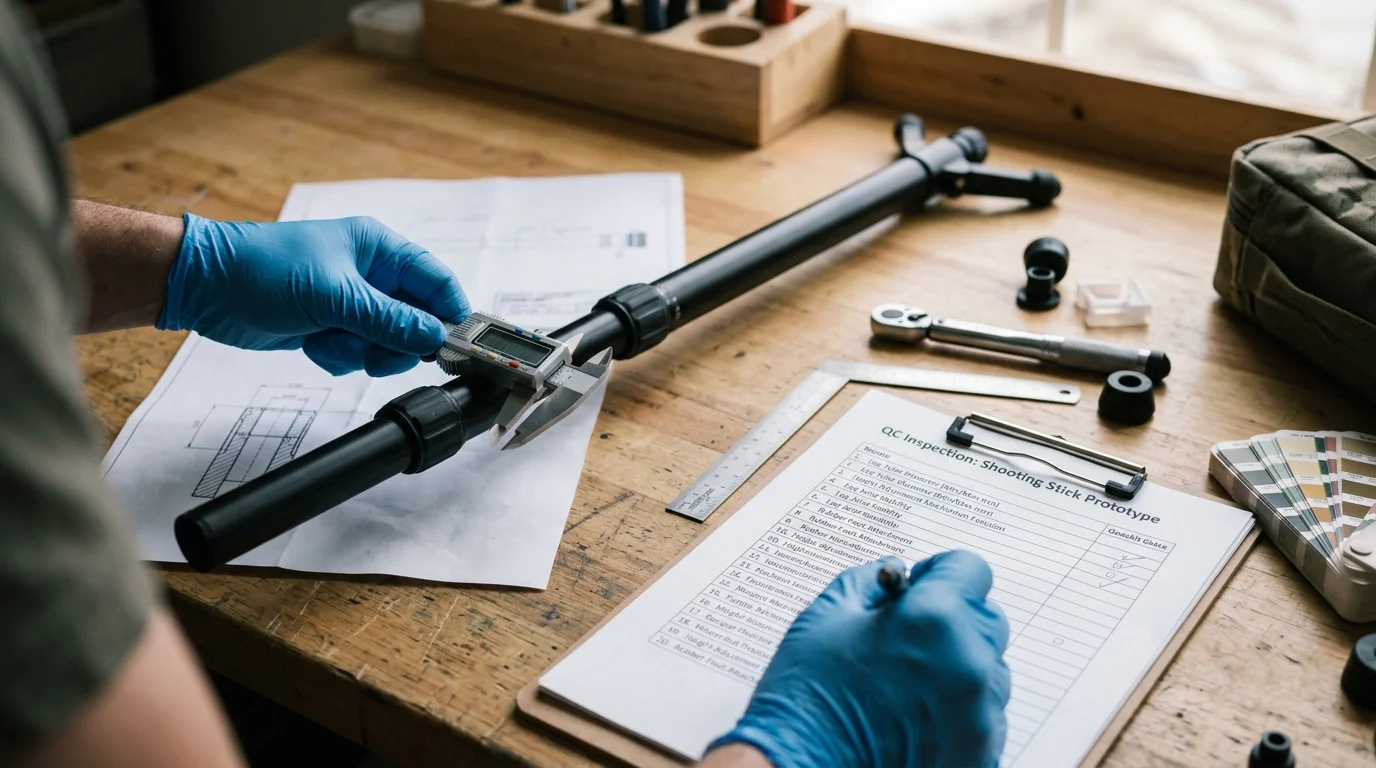
Before ever sending out a Request for Quotation (RFQ), product requirements must be locked down. Too many buyers make the mistake of asking a factory for their “standard shooting stick catalog” and just picking one that looks nice. If the specs aren’t defined by the buyer, the supplier will define them, and they will almost always optimize for their own manufacturing ease rather than the end-user’s field experience.
Sourcing a premium 4-legged shooting stick (see this reference link for a typical configuration) requires a granular understanding of terminology, materials, and dimensional tolerances. This involves essentially building a highly specialized tripod with an extra leg for dual-point rifle support. Let’s walk through the exact specifications that should be mandated in a tech pack.
Product types, terminology, and applications
First, terminology must be clarified, because factory reps and buyers often speak different languages. A “monopod” is a single stick, a “bipod” is two, and a “tripod” is three. It is important to note that a true 4-legged shooting stick is a niche category compared to dominant tripods and bipods, and it currently has limited independent testing standards. Mechanically, it typically consists of two V-yokes (one for the forearm of the rifle and one for the stock) supported by four independently adjustable legs. This functions more like paired bipods rather than a single-hub quadpod, creating a bridge-like cradle that locks the firearm in place and significantly reduces horizontal and vertical crosshair drift.
When discussing applications with a supplier, be clear about whether the stick is for heavy tactical rifles, lightweight hunting carbines, or crossbows. Each application changes the required load-bearing capacity of the yoke and the friction locks on the legs. If the target market uses heavy, 12-pound precision rifles, the locking mechanisms on a standard lightweight stick will slip. Specifying the application is critical to getting the right internal components.
Core specifications: folded length, weight, and height range
The core specifications are where the product is made or broken. If a “compact” stick doesn’t actually fit inside or strapped to a standard 30-liter hunting pack, customers will return it. Best practices dictate a folded length of no more than 28 to 32 inches. Anything longer catches on branches while the user is hiking.
Weight is equally critical. For an aluminum model, a total weight between 1.8 and 2.5 lbs is ideal. Moving to carbon fiber can push that down to 1.3 to 1.6 lbs. Height range is the third pillar: the stick must be usable sitting, kneeling, and standing. A strong benchmark is a collapsed height of around 35 inches and a maximum extended height of at least 62 to 65 inches.
| Specification Metric | Target Range (Aluminum) | Target Range (Carbon Fiber) | Critical Sourcing Note |
|---|---|---|---|
| Folded Length | 28″ – 32″ | 26″ – 30″ | Must strap seamlessly to a standard daypack. |
| Total Weight | 1.8 lbs – 2.5 lbs | 1.3 lbs – 1.6 lbs | Keep under 2.5 lbs to appeal to backcountry hunters. |
| Max Extended Height | 62″ – 65″ | 62″ – 65″ | Must comfortably support a 6-foot-tall standing shooter. |
| Min Usable Height | 35″ – 38″ | 35″ – 38″ | Crucial for sitting in ground blinds or steep inclines. |
Must-have features versus optional upgrades
When finalizing a spec sheet, non-negotiable “must-haves” must be separated from the “nice-to-have” optional upgrades that drive up cost. A must-have for a 4-legged system is independent leg adjustment. Terrain is never perfectly flat; if the legs only deploy at a fixed angle, the stick is useless on a hillside. Another must-have is all-weather grips—usually high-density EVA foam or textured rubber that won’t freeze or slip in the rain.
Optional upgrades are where a tiered product line can be built. For example, based on illustrative factory quotes, moving from twist-locks to premium lever-action flip locks typically adds a hypothetical $2.50 to $4.00 to the FOB cost per unit, but it allows for faster deployment. Swapping standard rubber feet for interchangeable carbide spikes (for ice and rock) is another common $1.50 upgrade that adds massive perceived value on the retail shelf. Knowing target margins is essential before approving every factory upgrade.
Compare Compact Hunting Sticks with Alternatives
One of the most common pushbacks from retail buyers is questioning the need to stock a 4-legged stick when shelves are already full of bipods and tripods. It’s a fair question, but it fundamentally misunderstands the field dynamics of modern hunting.
Comparing these tools side-by-side reveals that a height-adjustable shooting stick is a hybrid solution designed to solve the specific shortcomings of traditional supports, even though heavy-duty tripods remain the superior choice for absolute stationary stability in extreme long-range applications. Let’s look at how the compact 4-legged design stacks up against legacy alternatives.
Monopods, bipods, tripods, and fixed-height sticks
Monopods are lightweight and fast, but they offer terrible horizontal stability. Bipods attached to the rifle are great for prone shooting, but they are useless if the grass is taller than 12 inches. Tripods offer phenomenal stability—often locking the rifle in completely using an Arca-Swiss mount—and remain the superior choice for precision rifle series (PRS) or stationary overwatch where weight is not a concern. However, they are notoriously heavy, slow to deploy, and bulky for mobile hunters.
Fixed-height sticks are practically obsolete in today’s market because they restrict the hunter to a single shooting posture. As defined earlier, the modern 4-legged stick bridges this gap. By supporting both the front and the rear of the stock simultaneously, it mitigates the “see-saw” effect experienced with a standard tripod or bipod, allowing for precise shot placement without the weight penalty of a heavy-duty tripod bowl and ball head.
Stability, speed, portability, and field performance
In the field, success usually comes down to a balance of stability, speed, and portability. If a stick takes 30 seconds to set up, the animal is already gone. If it’s too heavy, the hunter leaves it in the truck.
| Support Type | Deployment Speed | Stability Score (1-10)* | Avg. Weight (lbs) | Best Field Application |
|---|---|---|---|---|
| Monopod | < 3 seconds | 3 / 10 | 0.8 – 1.2 | Fast, close-range brush hunting. |
| Rifle Bipod | < 5 seconds | 6 / 10 | 0.7 – 1.5 | Prone, long-range open country. |
| Heavy Tripod | 15 – 25 seconds | 10 / 10 | 4.0 – 6.0 | Stationary blind, precision rifle series. |
| 4-Legged Stick | 5 – 8 seconds | 9 / 10 | 1.8 – 2.5 | Spot-and-stalk, varied terrain, mid-to-long range. |
*Note: Stability scores and deployment speeds in the table above are illustrative field estimates based on subjective user experience, not standardized engineering data.
Based on comparative field estimates, the 4-legged design offers practical field stability that bridges the gap toward heavier tripods, but deploys in a fraction of the time and weighs less than half as much. This is exactly the performance narrative that resonates when pitching this product to retail partners or a direct-to-consumer audience.
Trade-offs between compact size and shooting support
Of course, there are trade-offs. Physics cannot be cheated. When a stick is engineered to be highly compact—meaning it requires 3 or 4 leg sections to fold down to 28 inches—more joints and locking mechanisms are introduced. More joints mean a higher potential for flex and mechanical failure if the manufacturing tolerances aren’t tight.
This is the primary trade-off between compact size and shooting support. A single-piece, fixed stick is incredibly rigid but impossible to pack. A highly compact 4-legged stick requires excellent engineering to maintain rigidity when fully extended. Liability risks must also be addressed: if a lock fails under a heavy firearm, it could result in equipment damage or injury to the user. This is why sourcing from bottom-tier factories is a non-starter. Suppliers must use CNC-machined aluminum joints rather than cheap injection-molded plastics at the critical stress points.
Source, Test, and Qualify Suppliers
Once specs and market positioning are dialed in, the real work begins: finding a factory that can actually execute. The sporting goods manufacturing sector is flooded with trading companies pretending to be factories, and factories that assemble cheap parts but lack true quality control.
To successfully source a reliable hunting shooting stick, a rigorous vetting process is required. This phase should be approached with a heavy dose of skepticism. Trust is earned through prototypes, stress tests, and strict compliance documentation.
Supplier shortlisting and RFQ process
When shortlisting suppliers, utilize global trade shows (such as SHOT Show or IWA) and vetted B2B platforms to identify and compare multiple factories rather than relying on a single source. Start by looking at their core competencies. The ideal factory specializes in camera tripods, trekking poles, or tactical gear—not a generalist that makes umbrellas and occasionally churns out a shooting stick. During the RFQ process, immediately ask for their Minimum Order Quantity (MOQ). A serious, quality-focused factory will typically require an MOQ of 500 to 1,000 units per colorway because they are sourcing high-grade aluminum tubing and custom extrusions.
Additionally, never passively trust a supplier’s claim of an “exclusive patent.” Explicit due diligence must be conducted. Legal teams should run independent patent searches in destination markets and verify all compliance certificates via recognized third-party testing labs to avoid infringement liability and secure legitimate distribution rights.
In the RFQ, demand transparent pricing based on ex-works or FOB terms. It is also critical to clarify ownership of tooling and molds at this stage, especially if you are paying for custom extrusions. Establish clear terms regarding ODM/OEM liability and ensure the supplier holds adequate product-liability insurance. For a standard 4-legged aluminum stick, illustrative wholesale pricing typically lands between $15 and $25 depending on the lock type and yoke materials. If a supplier quotes $8, proceed with caution. At that price, they are likely using recycled, brittle aluminum and plastic locks that will shatter in cold weather. Always ask for a “golden sample” before committing to a pilot run.
Quality tests for locks, joints, materials, and durability
Once the sample is in hand, it’s time to test its limits. Quality testing is non-negotiable. First, perform a load-bearing test on the locks. Extend the stick fully, lock the legs, and apply at least 50 lbs of vertical pressure. If the legs slowly slide or the locks pop open, the product is useless in the field.
Next, evaluate the joints and materials. The central pivot points where the legs meet the yoke should have zero lateral play. Industry experts also recommend a 48-hour salt spray test for any exposed metal parts to ensure the anodizing or powder coating can withstand wet, corrosive environments. Finally, put the stick in a commercial freezer for 12 hours, take it out, and immediately try to operate the plastic or rubber components. Cheap polymers will snap like twigs at sub-zero temperatures.
Compliance, packaging, labeling, and inspection requirements
Compliance and packaging might seem like an afterthought, but they can hold up a shipment at customs or ruin a product in transit. Ensure that any rubber grips or plastic yokes meet REACH compliance standards if selling in Europe, or California Prop 65 requirements if selling in the US. Be aware of regional regulatory differences in hunting equipment standards. Furthermore, factor in tariff exposure for finished goods made of aluminum or carbon fiber, which can significantly impact landed costs.
For packaging, insist on a 1.5-meter drop test for the master carton. These sticks are long and relatively heavy; if packed loosely in thin cardboard, the protruding metal feet will punch right through the box during shipping. Standard specifications should include 5-ply corrugated master cartons and individual retail boxes with internal blister packs or custom-cut EPE foam to keep the stick pristine from the factory floor to the store shelf.
Make the Final Buying Decision
With specs defined, prototypes tested, and the supplier list narrowed down, the next step is evaluating a spreadsheet full of quotes, lead times, and factory audit reports. Making the final buying decision isn’t just about picking the cheapest option; it’s about building a sustainable, profitable product line.
At this stage, relying on a structured evaluation method helps remove emotion from the equation. Whether launching a flagship carbon fiber hunting stick or a budget-friendly aluminum model, the final decision must balance risk against potential reward.
Decision matrix for price, quality, margin, and risk
A weighted decision matrix is highly effective for evaluating final factory bids. Typically, quality and test performance can be weighted at 50%, price and margin potential at 30%, and supplier risk (which includes lead times and communication) at 20%. If a factory offers a fantastic price of $16 FOB but has a 90-day lead time and failed the cold-weather lock test, their overall score tanks.
Standard lead times for this category should be 45 to 60 days after sample approval, but seasonal manufacturing shutdowns (such as the Lunar New Year in Asia) must be accounted for, as they can severely delay production. If ordering for the fall hunting season, ocean freight times must be factored in. A factory that can reliably hit a 45-day production window is often worth paying a 5% to 10% premium per unit, simply because it reduces inventory risk and ensures the peak retail buying window isn’t missed.
Good, better, and best product positioning
The best way to maximize return on investment is to use the chosen supplier to create a “Good, Better, Best” product architecture. It isn’t necessary to source three entirely different sticks; the same base chassis can be used while altering the materials.
A hypothetical “Good” model might feature 6061 aluminum tubing with basic twist locks, landing at an illustrative $18 FOB cost and retailing for $69. A “Better” model steps up to stronger 7075 aluminum, lever flip-locks, and upgraded yoke padding, costing around $25 FOB and retailing for $99. Finally, a “Best” model swaps the aluminum for premium carbon fiber, drops the weight to 1.4 lbs, costs roughly $45 FOB, and commands a premium $179 retail price. This strategy captures buyers at every budget level while consolidating factory orders.
Final checks before placing a bulk order
Before wiring a 30% deposit for a bulk order, there are a few final checks to implement. First, write a strict Acceptable Quality Limit (AQL) into the purchase order. For shooting sticks, it is standard practice to demand an AQL of 1.5 for major defects (like broken locks or missing parts) and 4.0 for minor defects (like slight scratches on the paint).
Second, negotiate spare parts into the initial order.
Key Takeaways
- Prioritize compact hunting sticks that combine fast deployment, low packed volume, and field-ready stability to meet modern hunter expectations.
- Source height adjustable shooting sticks that cover sitting heights near 35 inches and standing heights above 60 inches for broader use-case coverage.
- Target lightweight designs under 2.5 lbs when serving spot-and-stalk hunters who may hike 5 to 10 miles per day.
- Use 4-legged shooting stick designs to differentiate from basic monopods and support premium retail positioning.
- Evaluate margin potential carefully, as well-sourced premium shooting sticks can support estimated retail gross margins of 40% to 60%.
Frequently Asked Questions
Why should buyers consider compact hunting sticks for their portfolios?
Compact hunting sticks meet demand for lighter, faster-deploying field gear. They appeal to hunters who want stability without carrying bulky equipment, making them a strong fit for premium outdoor retail and distribution assortments.
What makes a 4-legged shooting stick commercially attractive?
A 4-legged shooting stick offers greater stability than basic monopods or bipods, especially for longer shots and uneven terrain. This added performance supports higher retail positioning and can improve perceived value for serious hunters.
Which customer segments are most likely to buy height adjustable shooting sticks?
Key buyers include spot-and-stalk hunters, predator hunters, and ground-blind users. These customers need lightweight support that adjusts from seated positions around 35 inches to standing positions over 60 inches.
What weight range should sourcing teams prioritize?
Many mobile hunters prefer support gear under 2.5 lbs, especially when hiking long distances. Lightweight aluminum designs can help meet this demand while maintaining durability and packability.
What retail price range is realistic for premium compact shooting sticks?
Premium compact systems often sell in the $100 to $250 retail range, depending on materials, adjustability, stability, and brand positioning. Strong feature differentiation can support higher margins.
Post time: Jul-24-2026